Business Desk:
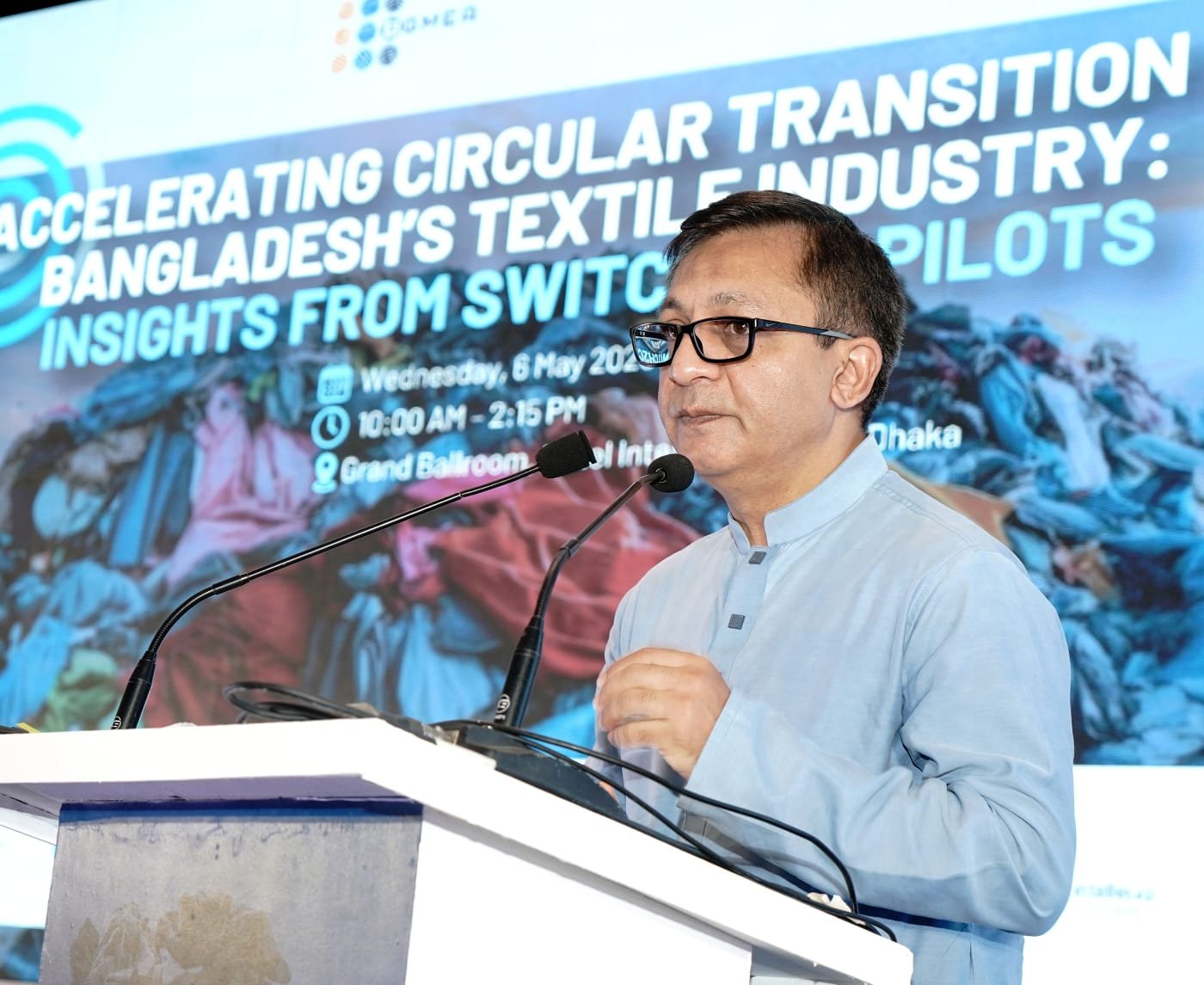
Commerce Minister Khandaker Abdul Muktadir has said that transition to circular economy is no longer just an environmental issue; it is one of the main prerequisites for strengthening Bangladesh’s industrial sector’s future competitiveness, sustainable growth and position in the global market.
He said, “The global market is changing rapidly. Sustainable production is now one of the determinants of competitiveness in international trade. Buyers, investors and consumers are now interested in production systems that bear the hallmarks of efficiency, responsibility and long-term stability.”
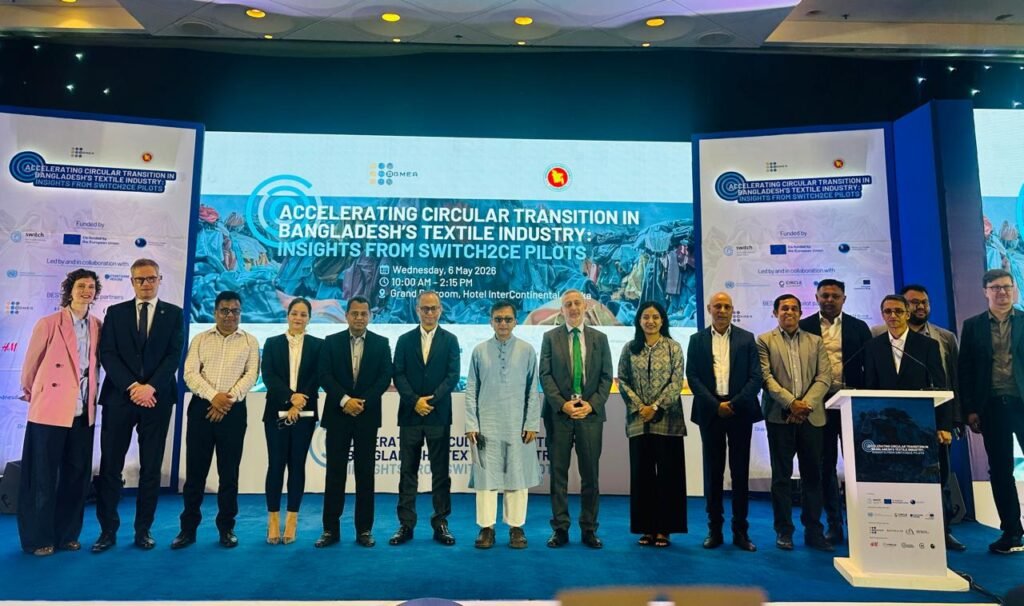
He made these remarks while addressing the special seminar titled “Accelerating the Transformation of Circular Economy in Bangladesh through SWITCH2CE Pilot Initiative” jointly organized by the Ministry of Commerce and the Bangladesh Garments Manufacturers and Exporters Association (BGMEA) at the Intercontinental Hotel in the capital on Wednesday (May 6, 2026).
Secretary (Routine Responsibilities) of the Ministry of Commerce Md. Abdur Rahim Khan presided over the seminar. Special guests included Ambassador of the European Union to Bangladesh Michael Miller and BGMEA President Mahmud Hasan Khan.
The Commerce Minister said that the pilot activities conducted under the “SWITCH to Circular Economy” program have already proven that the transformation to a circular economy is not a far-fetched idea; it is realistic, achievable and its implementation has already begun.
He said that the pilot activities conducted in collaboration with H&M Group and Bestseller have created effective experiences in textile waste management, recycling systems and value chain coordination in the textile and garment sector of Bangladesh. These experiences will serve as an important foundation to move the Bangladeshi industry towards a structural and holistic circular transformation.
Khandaker Abdul Muktadir said that through the circular economy, it will be possible to ensure efficient use of resources, reduce waste, strengthen the stability of the supply chain, increase innovation and value addition, and further consolidate Bangladesh’s position in the global market.
He also said that since the textile and garment sector is highly resource-dependent, the transformation to a sustainable production system based on recycling and recyclability will play an important role in reducing environmental pressure and advancing sustainable industrialization.
The minister said that the circular transformation will be successful only when the government, the industry, global brands, technology providers and development partners work together. He noted that the experience gained from the pilot activities and the ongoing initiative to formulate a national strategy have created a solid foundation for future activities.
Expressing the government’s position, he said that the government is committed to creating a supportive environment to encourage innovation, support sustainable investment and strengthen cooperation among stakeholders.
At one point in his speech, the Commerce Minister raised the issue of LDC graduation and said, “After LDC graduation, Bangladesh will have to face a completely new economic reality. We will lose low-interest credit facilities and many LDC-based trade preferences. Therefore, we need to make our economy more competitive and investment-friendly from now on.”
He said that currently Bangladesh’s logistics cost to GDP ratio is about 16 percent, while the global average is about 10 percent. The government has taken effective initiatives to reduce this cost. A Danish company has already been given the responsibility of operating a terminal to increase the efficiency of Chittagong Port, and there are plans to involve more internationally skilled organizations in the future.
Regarding the facilitation of the investment environment, he said that currently entrepreneurs have to go to many institutions for various approvals and licenses, which is time-consuming and complicated. The government is going to introduce a system where an organization will get temporary approval after registration and can start operations immediately. There will be an opportunity to obtain the necessary permanent approvals and licenses within the next 12 months.
He also said, “We want to turn the one-stop service into a true one-stop service. Investors will no longer have to move from one office to another.”
The Commerce Minister said that to survive in the current global reality, every product produced in Bangladesh—ready-made garments, medicines, leather products or jute products—must be sustainable.
He said, “The world has realized today that human civilization cannot survive by destroying the environment and ecosystem. However, there is also a realization among people in the developing world that developed economies are mainly responsible for the current carbon and pollution crisis. Therefore, developed countries must take the lead in building a sustainable global future.”
Speakers at the seminar emphasized the expansion of the circular economy in Bangladesh’s textile and garment sector, sustainable production systems and increasing international cooperation.