Desk Report:
In the past, upscale and mid-range shopping malls in various parts of the capital were bustling hubs, drawing large crowds of shoppers. However, shopping habits, consumer preferences, and purchasing power have evolved over time. Many of these malls are now struggling to survive, unable to compete with the low-cost stalls that have proliferated along the city’s footpaths. Faced with a dwindling customer base, some shops are closing down, while others are preparing to shut their operations entirely. Meanwhile, these unregulated businesses—which occupy public footpaths—not only cause the government to lose significant revenue but also exacerbate traffic congestion and public hardship. Given this situation, simply evicting street vendors is not enough; it has become essential to register them, provide designated spaces for their businesses, and bring them under a system of regular oversight.
Karnaphuli Garden City Shopping Complex in the capital’s Kakrail area serves as a notable example. Established toward the end of the last century, this mall was once a preferred destination for middle- and upper-class shoppers, who flocked there to purchase everything from clothing, footwear, and cosmetics to jewelry. As the number of customers steadily declined, the mall’s commercial viability weakened. The situation reached a point where, on October 1, the shop owners collectively decided to shut it down.
Karnaphuli Garden City began its operations within the basement and the first four floors of a 20-story building constructed by the Karnaphuli Group in 1998. The remaining floors of the building house residential apartments. The shopping complex contained 198 individual shops, owned by 125 different business owners. After enduring long-term losses, these owners have ultimately decided to close their shops and sell off their properties.
A similar situation to that of Karnaphuli Garden City is being observed in several other shopping malls across the capital. Eastern Plaza, once known as an upscale shopping destination, has lost its former luster and is now in a state of decline. Similarly, Eastern Mallika, Police Plaza, Rapa Plaza, Shimanto Square, Hosaf Tower, Mouchak Market, Shah Ali Market in Mirpur, and Century Arcade are seeing significantly fewer customers than in the past. Merchants in these shopping centers have been facing losses for a long time; if the situation does not improve, many may be forced to close their businesses.
These shopping malls were originally established with middle-class and lower-middle-class consumers in mind. However, a large segment of these shoppers now prefer to buy from sidewalk stalls, as many products of comparable quality to those found in malls are available on the streets at lower prices. Consequently, consumers are turning to sidewalk vendors to take advantage of these cost savings.
The cost structures for businesses in shopping malls and those on the sidewalk differ significantly. Shop owners in malls must cover expenses such as rent, electricity bills, VAT, and various taxes. In contrast, most sidewalk vendors do not bear these regular costs, allowing them to offer lower prices. Yet, this lower pricing comes with a major drawback: most sidewalk stalls lack legal registration, proper oversight, or accountability. There are also frequent complaints regarding the sale of substandard goods and the deception of customers.
While consumers may save money by purchasing cheaper goods, it is essential to consider the broader economic impact. A vast volume of goods is sold through these unregistered businesses, yet the government receives no corresponding revenue—depriving the state of income from sources like VAT and income tax. This revenue shortfall ultimately affects the national economy. In other words, while shopping at lower prices may seem advantageous to the individual, unregulated business activities cause long-term harm to the economy.
The operation of businesses on sidewalks is sustained by an informal system. In many instances, there are allegations of collusion involving influential local figures, politically powerful circles, and certain members of law enforcement agencies. It is alleged that these illicit operations are sustained through the regular collection of payments from street vendors. Consequently, while the vendors continue their trade, the government receives no revenue from these activities; instead, it is the general public who ultimately pays the price.
The encroachment upon footpaths deprives pedestrians of the ability to move about freely, forcing them to walk along the main roadways. This obstructs both vehicular and pedestrian traffic, leading to increased congestion. Such traffic congestion not only results in the loss of productive work hours but also harms the national economy. Furthermore, the haphazard placement of stalls detracts from the city’s aesthetic appeal and, in some areas, raises concerns regarding a potential deterioration of law and order.
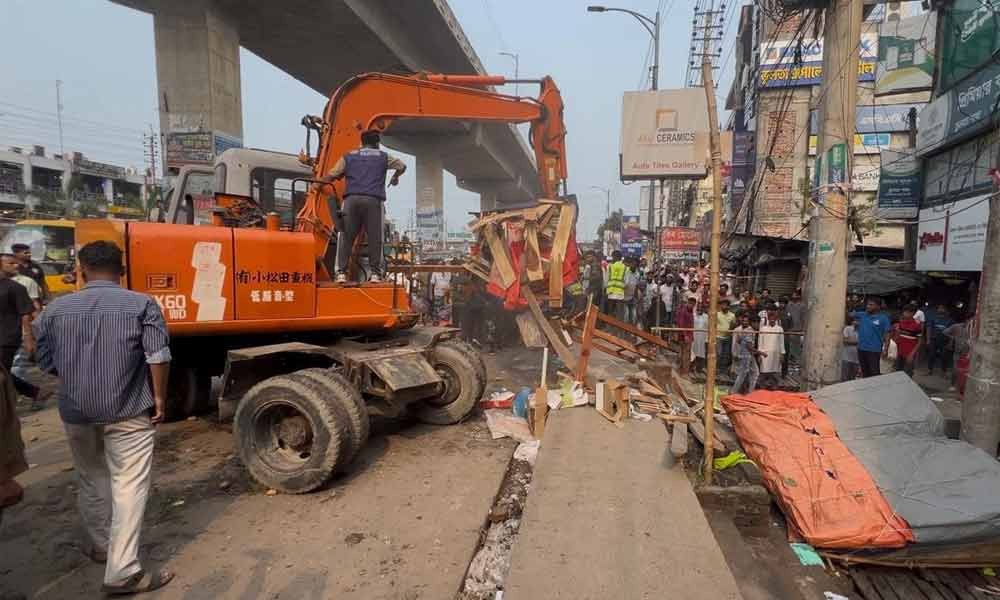
In light of this situation, the capital’s two city corporations have initiated efforts to clear the footpaths of encroachments. The objective is to bring street vendors into a regulated framework while restoring the right of way to pedestrians. Already, vendors have been removed from footpaths in the Mirpur, Uttara, and New Market areas, with plans to extend these operations to other parts of the city.
Recently, the Dhaka South City Corporation (DSCC) conducted an operation to clear the footpaths in front of the capital’s New Market area. To prevent the re-establishment of stalls following the eviction, over a hundred tree saplings were planted along the footpaths. Meanwhile, a visible transformation has taken place in the vicinity of the Mirpur-10 roundabout following similar eviction drives. With the reduction of long-standing traffic congestion and the dispersal of vendor clusters, pedestrians are now able to move around with significantly greater ease.
This will also have a positive impact on alleviating human suffering.
Last April, the Prime Minister instructed the relevant authorities to arrange alternative employment for street vendors. In light of this directive, the possibility of relocating them from the footpaths to designated alternative business sites is now being considered. Simply evicting them and cutting off their means of livelihood would not provide a permanent solution; their employment needs must be given equal importance.
Although drives to clear footpaths have been conducted in the past, vendors have often returned within a few days. In many areas, the previous situation was restored either through arrangements with local political leaders or due to the intervention of influential figures. To prevent a recurrence of this, the City Corporation is prioritizing the implementation of alternative arrangements.
The Dhaka North City Corporation (DNCC) is currently searching for suitable locations to rehabilitate the displaced vendors. Under the proposed plan, they may be granted the opportunity to conduct business regularly at designated sites. Relying solely on ‘holiday markets’—which operate only two days a week—would make it difficult for many vendors to support their families; therefore, the option of allowing daily business operations in specific areas is being considered. A potential schedule under discussion involves operating from the afternoon until 11:00 PM. If necessary, boundary walls could be constructed at these locations.
However, a crucial aspect of this rehabilitation process must be ensured: no political group, local influential figure, or any other party should be able to illegally extort money from the vendors. A reasonable fee or service charge, in accordance with the City Corporation’s established regulations, could be collected instead. This would foster a legitimate business environment for the vendors, while a portion of their earnings would contribute to government revenue.
According to official government records, there are over 600,000 street vendors across the country, with approximately 400,000 in Dhaka city alone. Of these, about 130,000 are members of various associations, while the remaining 270,000 operate as itinerant (mobile) vendors. However, various non-governmental estimates suggest that the actual number of street vendors nationwide is no less than 2 million. This discrepancy in the figures highlights the urgent need to create a comprehensive and reliable list of street vendors.
Bringing street vendors under a registration system would provide accurate data regarding their actual numbers, the nature of their businesses, and their operating locations. Furthermore, it would facilitate the collection of prescribed registration fees and regular service charges. Currently, a significant portion of the money collected from street vendors by various entities never reaches the public exchequer. Implementing a transparent management system would allow a share of these funds to contribute to state revenue.
Registered vendors could be provided with identification cards, designated business locations, specific operating hours, and quality control standards for their goods. This would not only legitimize their businesses but also safeguard the interests of consumers; if complaints arise regarding product quality, action can be taken against the vendor in question. Additionally, this would create a more balanced competitive environment between street vendors and businesses in shopping malls, as both parties would be required to operate within a framework of established rules and financial accountability.
Many countries around the world have long grappled with issues related to street vending. However, through well-planned management, several nations have transformed these challenges into economic opportunities. The experiences of the United Kingdom, Singapore, and Thailand are particularly noteworthy; rather than resorting to total eviction, these countries have integrated street vendors into a formal system—assigning them specific locations, operating hours, and registration requirements.
In Bangkok, the capital of Thailand, street vendors once caused significant problems, including traffic congestion, hardships for pedestrians, and various issues affecting the tourism sector. Many vendors operated in arbitrary locations by making payments to influential local figures or other relevant individuals. Due to the lack of registration, it was difficult to identify these vendors or take action against any irregularities.
To address this, the authorities in Bangkok first initiated the creation of a comprehensive list of street vendors. Subsequently, registration was made mandatory, and vendors were issued identification cards. Specific zones, designated spots for stalls, and operating schedules were established for registered vendors. At the same time, a system was introduced to collect monthly government fees from them. According to available information, this fee was initially set at 100 baht, but was later increased to 1,500 baht.
This system brought the businesses of street vendors into a formal, institutional framework. At the same time, by regulating the use of sidewalks, it facilitated better pedestrian movement and improved traffic management. Today, various street markets and street food hubs in Thailand serve as major tourist attractions. Similarly, in Singapore, well-planned night markets and hawker centers contribute significantly to both tourism and the local economy.
These examples demonstrate that the livelihoods of street vendors and urban order are not mutually exclusive; with proper planning, both can be achieved. In fact, vendors themselves would benefit if, instead of occupying sidewalks in an unregulated manner, they were provided with the opportunity to conduct business in designated areas according to established rules.
To implement a similar system in Bangladesh, the first step is to formulate a national-level policy for street vendors. This policy should include the registration of vendors nationwide, the issuance of identification cards, the classification of businesses by type, and the designation of specific work locations. In Dhaka, suitable sites could be identified to develop markets or designated business zones specifically for street vendors.
To implement such a system in Bangladesh, the first step is to formulate a national-level policy for street vendors. This policy should encompass the registration of vendors nationwide, the issuance of identification cards, their classification based on the nature of their business, and the designation of specific operating locations—with particular consideration given to the unique context of Dhaka city. Furthermore, a daily or monthly service charge could be levied, contingent upon the business location and the facilities provided. In exchange for these payments, vendors must be guaranteed safety, business security, and an environment free from extortion. It would be the responsibility of law enforcement agencies and local administrations to halt illegal collections and ensure adherence to established regulations.
Designated areas for street vendors must be equipped with proper sanitation, waste management, security, electricity, and essential civic amenities. Simultaneously, the practice of setting up stalls on footpaths or roads outside of permitted hours must be prohibited. Violations should be met with measures such as warnings, fines, or, if necessary, the revocation of registration. It is crucial to ensure that neither political nor administrative influence obstructs the enforcement of these rules.
Evicting street vendors is not the sole solution; the primary objective should be to integrate them into a structured and legal framework for employment. This would safeguard the rights of pedestrians to use footpaths while simultaneously protecting the livelihoods of the vendors. It would also provide the government with a new source of revenue, curb illegal extortion, and create opportunities for regulating product quality.
Additionally, shopping complexes—such as Karnaphuli Garden City—could find relief from the pressures of unregulated and unfair competition. Just as businesses within shopping malls bear the costs of rent, taxes, and other operational expenses, street vendors would also operate under a system of defined fees, clear regulations, and accountability.
Keeping footpaths free from encroachment and rehabilitating street vendors should be viewed as complementary processes. This initiative will only succeed if it moves beyond mere eviction drives and incorporates long-term planning, transparent registration, consistent oversight, and effective measures to eliminate extortion. This will not only enhance the city’s aesthetics and the environment for movement, but also create opportunities for positive change in areas such as employment for street vendors, business in shopping malls, and state revenue.