Staff Correspondent:
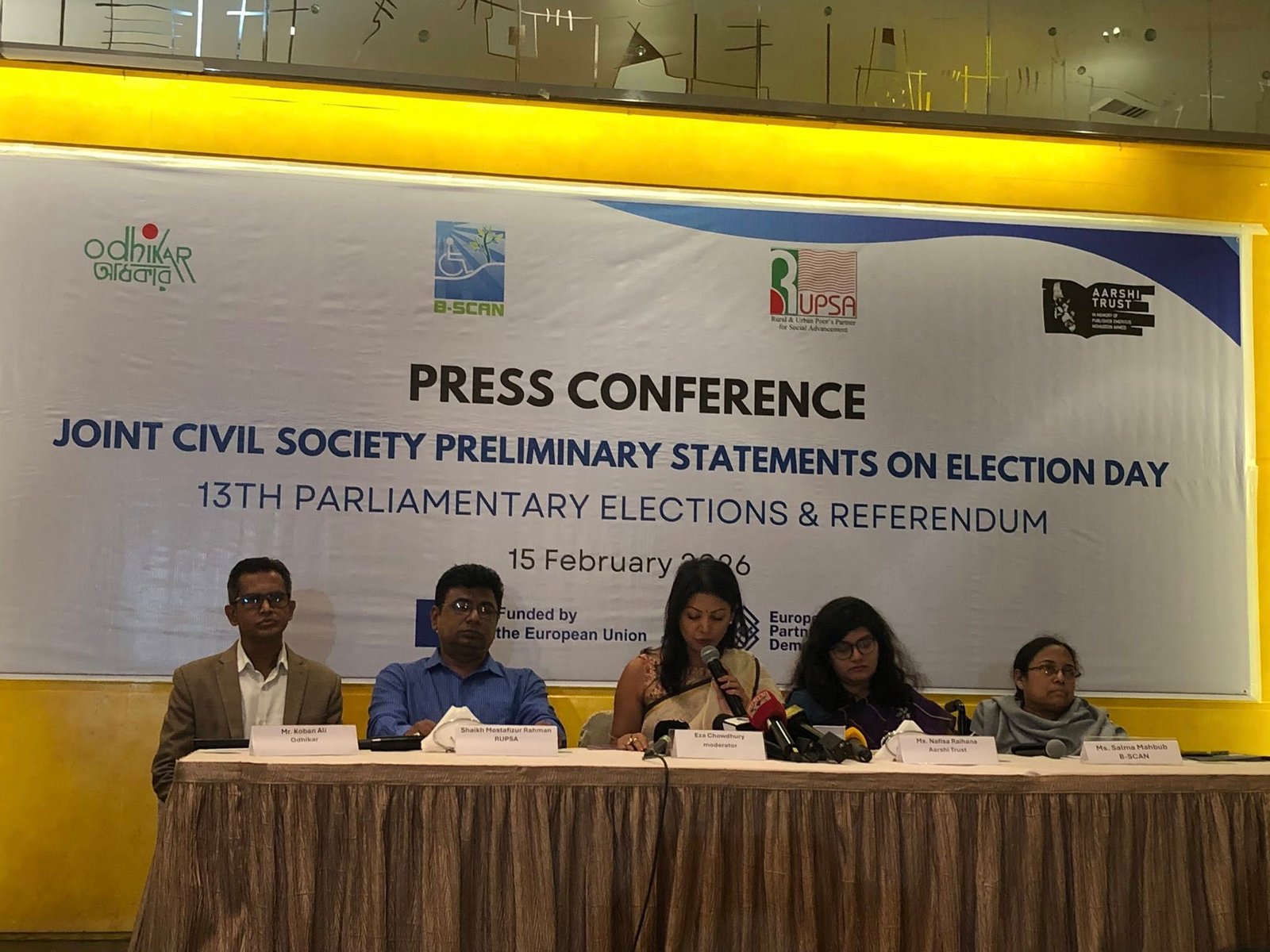
B-Scan, an organization of people with disabilities, has released a preliminary statement on the participation and accessibility of people with disabilities in the 13th national parliamentary election and referendum held on February 12. The organization said that for the first time in Bangladesh, a disabled people’s organization has received formal approval to observe the election, which is an important step towards inclusive democracy. However, structural, institutional and legal obstacles still remain to ensure full and effective participation.
B-Scan said that 100 trained disabled observers were deployed at 110 polling stations in Faridpur, Dinajpur, Meherpur districts and Dhaka North and South City Corporation areas. They closely observed the start of voting, the voting process and the counting process. The organization claims that its observers performed their duties independently and impartially, adhering to the code of conduct, and paying special attention to the participation of voters with disabilities.
The organization conducted a Policy Gap Analysis in the run-up to the elections. It found that although Bangladesh is a signatory to the United Nations Convention on the Rights of Persons with Disabilities, that commitment is not fully reflected in electoral laws and processes. The analysis identified a lack of clear recognition of persons with disabilities as full rights holders, the absence of mandatory accessibility standards, ambiguity in the assisted voting process, and limitations in accountability in election management.
The accessibility assessment found that most polling stations—especially school buildings—are still not adequately accessible. 44 percent of stations had stairs at the entrance, and in most cases, there were no alternative ramps. Where ramps were available, almost none were built to the recommended slope ratio. In addition, the lack of polling stations on the ground floor, inadequate signage, and transportation constraints disproportionately affected voters with disabilities.
On election day, the observation showed that the presence of persons with disabilities was observed in 78 percent of polling stations and in two-thirds of the stations they were able to vote independently. In 73 percent of the stations, the space inside the polling station was wide enough for wheelchair users. However, in some cases, restrictions were observed in the free expression of opinions of voters with neurodevelopmental disabilities, and election officials marked the ballot in their favor—raising questions of privacy and independence.
In terms of arrival and entry to the polling station, while unhindered movement up to the main entrance was ensured in 74 percent of the stations, the entrance was wheelchair-accessible in 60 percent of the stations. In about 80 percent of the stations, the movement path was clear, which was helpful for physically challenged voters.
In terms of polling station and priority facilities, voters with disabilities did not have to wait in line in 74 percent of the stations. However, in 15 percent of the stations, they had to stand in the general line. Priority facilities were provided in 51 percent of the stations. Although the width of corridors and doors in two-thirds of the centers was standard, easy accessibility was not ensured as half of the polling stations were not on the ground floor.
The information and communication system showed that officials in all centers were aware of the code of conduct for persons with disabilities and reported being trained. However, 41 percent of the information was out of reach of wheelchair users or people of short height. 36 percent of the information was not readable for people with visual impairments or neurodevelopmental disabilities, and in 46 percent of cases it was partially readable.
B-Scan said that the cooperation of election officials in providing assistance was positive. A large proportion of visually impaired voters received assistance and in most cases confidentiality was maintained. However, one-fifth of people with neurodevelopmental disabilities were not able to vote successfully, which highlights the need for improved support systems and quality guidance.
The organization said that it will continue its monitoring activities in the post-election period. The experiences of voters with disabilities will be collected through online surveys and focus group discussions. A final report will be published based on the entire process, which will include recommendations to strengthen the inclusion of persons with disabilities in future elections.
According to B-Scan, inclusive elections are not just a matter of goodwill; they depend on legal harmonisation, mandatory accessibility standards and effective implementation. Without these guarantees, the right to vote for persons with disabilities, while recognized on paper, remains limited in practice.