Desk Report:
Civil Aviation and Tourism Minister M Rashiduzzaman Millat has stated that the government is working to transform the country’s aviation sector into a robust regional aviation hub, aiming to turn Bangladesh’s economy into a trillion-dollar economy by 2034.
He remarked that the aviation sector plays an undeniable role in the country’s economic advancement. An airport serves as a gateway to a nation and acts as a mirror reflecting the state itself. Therefore, an aviation master plan is being formulated to ensure the planned and integrated development of the country’s airports.
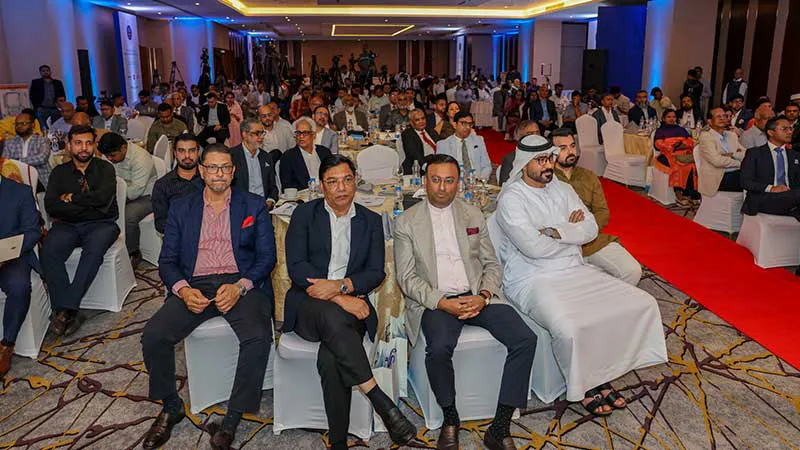
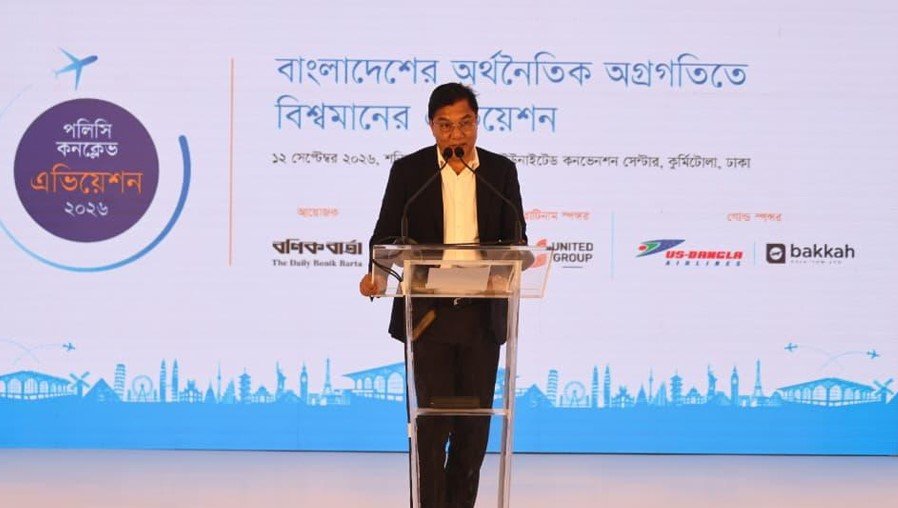
He made these remarks on Sunday (September 12, 2026) while speaking as the chief guest at a policy conclave—organized by Bonik Barta at the United Convention Hall in the capital—focused on the potential of the aviation sector, policy reforms, and future courses of action. State Minister for Foreign Affairs Humayun Kabir attended the event as a special guest. Air Vice Marshal (Retd.) Mahmud Hossain, former Chairman of the Civil Aviation Authority of Bangladesh (CAAB), presented the keynote paper. Over four hundred representatives—including policymakers, experts, diplomats, entrepreneurs, and delegates from various domestic and international organizations—participated in the conclave.
The Aviation Minister stated that the ‘Civil Aviation Rules-1984’ are being amended after nearly 42 years to formulate the new ‘Civil Aviation Rules-2026’. The new regulations will include provisions to make the aviation sector conducive to business and private investment, while also enhancing passenger service quality and ensuring the safety and security of civil aviation operations.
Addressing airline representatives, he said, “You are our key stakeholders.” He emphasized the need to ensure the spontaneous participation of airlines in the processes of simplifying investment and formulating the new regulations. The Minister stated that initiatives are underway to amend aircraft maintenance regulations to better accommodate private airlines, noting that steps have also been taken to resolve existing complexities regarding the maintenance, repair, and overhaul of complex aircraft components.
He remarked that the current government inherited a fragile and chaotic aviation sector, plagued by complaints of passenger harassment at airports and in air travel services; mitigating such harassment is a key government objective. Efforts are being made to appoint a second ground handler alongside Biman Bangladesh Airlines to improve service quality. Simultaneously, plans are in place to establish an international-standard Maintenance, Repair, and Overhaul (MRO) unit to facilitate aircraft maintenance for both domestic and foreign airlines.
He added that necessary measures would be taken to streamline the processes for establishing civil airports through private initiatives and expanding existing airports. Acknowledging that implementing these government initiatives requires time, the Minister sought the cooperation of all relevant stakeholders.
Addressing the media, M Rashiduzzaman Millat noted that misinformation regarding airport-related matters is circulating on social media. In this context, he urged the country’s media outlets—including Bonik Barta—to play a more vigilant and responsible role in countering misinformation and misleading information. He affirmed that the current government believes in media freedom and is committed to maintaining an environment conducive to responsible and independent journalism.
State Minister for Foreign Affairs Humayun Kabir stated that transforming Bangladesh into a regional aviation hub requires developing airport infrastructure, enhancing the national airline’s capacity and modernization, and ensuring international-standard ground handling services. He emphasized that no external entity would step in to do this work on Bangladesh’s behalf; the sector must be advanced under the country’s own leadership.
He highlighted the need to prioritize expanding the aircraft fleet, increasing new routes and flight frequencies, boosting cargo and freight capacity, and establishing MRO facilities to advance the nation’s aviation sector. At the same time, he stressed the importance of establishing local aviation training centers of international standards to produce skilled pilots, airline engineers, and ground staff. Humayun Kabir stated that the government aims to maintain an open-sky policy as much as possible. The goal is to develop Bangladesh into a regional aviation gateway that expands connectivity with Southeast Asia, the Middle East, and other parts of the world. He highlighted the potential to transform Bangladesh’s airports into significant hubs for international transit and connectivity, similar to Dubai International Airport.
Regarding the Third Terminal at Hazrat Shahjalal International Airport, the State Minister for Foreign Affairs noted that government discussions concerning Terminal-3 have progressed rapidly, and an agreement is in the final stages. A “win-win” agreement will be ensured, keeping national interests and the welfare of the people in mind. A “soft opening” of the terminal is likely to take place in December, with full operations expected to commence between March and April. He also mentioned that, at full capacity, Terminal-3 would facilitate the handling of approximately 12 million passengers annually.
He further added that once Terminal-3 becomes operational, its operational readiness, passenger transfer systems, and other services must be upgraded to international standards. Simultaneously, opportunities must be seized to enhance air connectivity with South Asia, Southeast Asia, China, Japan, and Korea, while also leveraging partnerships with low-cost airlines and establishing new gateways.
The State Minister for Foreign Affairs stated that the policy and regulatory environment must be made more business-friendly to foster the development of the aviation sector. He expressed optimism regarding the sector’s reform initiatives under the leadership of Aviation Minister M. Rashiduzzaman Millat and emphasized the importance of greater private sector involvement.
Participating in the discussion, KM Mujibul Haque, Chairman of Total Air Services Limited, noted that the inauguration of the Third Terminal would create the capacity to handle 20–24 million passengers and 500,000 tonnes of cargo annually. The key challenge now lies in maximizing this capacity. Currently, the country’s aviation market is valued at $5–6 billion, with domestic airlines holding only a 22% share. Approximately $1.16 billion flows abroad annually due to air travel. Despite possessing assets worth nearly $25 billion, the sector contributes only 0.8% to the GDP. He remarked that with a strategic approach, the size of the country’s aviation market could be expanded to $15 billion.

Mohammed Abdullah Al Mamun, Managing Director of US-Bangla Airlines, stated that ensuring a level playing field for domestic airlines is essential to transforming Bangladesh into an aviation hub. With policy support and equal opportunities, domestic airlines could strengthen their position and compete effectively in the international market.
During the open discussion, Abdul Hai Sarker, Chairman of the Bangladesh Association of Banks (BAB) and Dhaka Bank PLC, observed that the aviation sector could serve as a vital source of increased national revenue. He noted that securing adequate aircraft, modern equipment, and a skilled workforce could exponentially boost the sector’s earnings. Such measures would not only attract foreign passengers but also significantly enhance the aviation sector’s contribution to the national economy.
Stakeholders at the conclave engaged in detailed discussions regarding the existing challenges and prospects of the aviation sector, necessary policy reforms, and actionable steps to address these issues.