Desk Report:
Finance and Planning Minister Amir Khasru Mahmud Chowdhury has stated that spontaneous self-regulation and the practice of good governance by all market stakeholders are essential to restructure and strengthen the capital market, lifting it from its current fragile state.
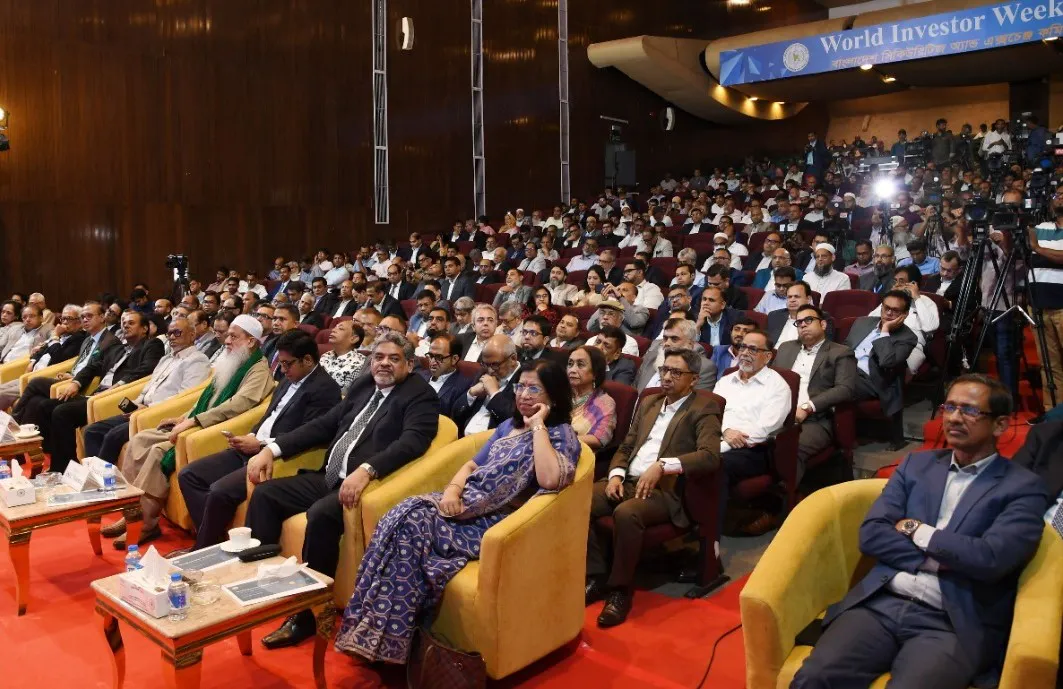
He made these remarks on Sunday (October 4, 2026) while speaking as the chief guest at the inaugural ceremony of ‘World Investor Week 2026,’ jointly organized by the Bangladesh Securities and Exchange Commission (BSEC) and the International Organization of Securities Commissions (IOSCO) at the Krishibid Institution Auditorium in the capital.
Highlighting the current economic context, the Finance and Planning Minister noted that despite various institutional and infrastructural developments in the capital market—such as automation and the establishment of the CDBL—the market has overall failed to yield positive results. Consequently, alongside the broader economy, our capital market has fallen into a deep crisis. We are currently attempting to rescue it, a process that requires us to make some difficult and painful decisions.
Emphasizing the need for a radical shift in the country’s economic financing structure, the Minister observed that our economy has long relied primarily on bank loans. However, funding long-term needs with short-term deposits has created various complications. To keep pace with world-class economies, we must now transition from ‘High Street to Wall Street.’ We need to focus on bond markets, derivatives, securitization, and equity markets to secure long-term financing.
The Minister reported a positive response from international investors and global markets. Renowned global investors recently expressed deep confidence in Bangladesh’s transformation and economic initiatives during a meeting held on Wall Street in the United States. He stated that initiatives are underway to launch dollar bonds in New York and a ‘Bangladesh Dedicated Fund’ in Hong Kong. Simultaneously, the financing structure of Bangladesh’s public and private sectors will be transformed through global financial products such as Samurai bonds and Panda bonds. Realizing the vision of transforming Bangladesh into a trillion-dollar economy by 2034 requires an annual investment of approximately $50 billion—a target that cannot be met solely through conventional foreign loans.
The Minister emphasized the need for self-regulation and professionalism within the capital market. He noted that the BSEC alone cannot bring about miraculous changes; rather, every stakeholder—including brokers, stock exchanges, depositories, credit rating agencies, and the Financial Reporting Council—must ensure ethical standards and institutional capacity to self-regulate. He urged market participants to proactively ensure transparency and trust, rather than waiting for directives from the regulator. He called upon all market-related institutions to work collaboratively, prioritizing ethical responsibility over mere regulatory compliance. He expressed optimism that the landscape of the Bangladeshi capital market would undergo a positive transformation within the coming year. The Minister then formally inaugurated the event.
Presided over by Masud Khan (FCA, FCMA), Chairman of the Bangladesh Securities and Exchange Commission (BSEC), the event was attended by Tanvir Shahriar Goni, Special Assistant to the Prime Minister (Investment and Capital Market Affairs), as the Guest of Honour. Special Guests included Nazma Mobarek, Secretary of the Financial Institutions Division (Ministry of Finance), and Mir Nadia Nivin, Chairman of the Insurance Development and Regulatory Authority (IDRA).
High-ranking officials from the BSEC, the Ministry of Finance, Bangladesh Bank, the NBR, and various capital market-related institutions, along with international delegates and a large number of investors, were present at the event.