Desk Report:
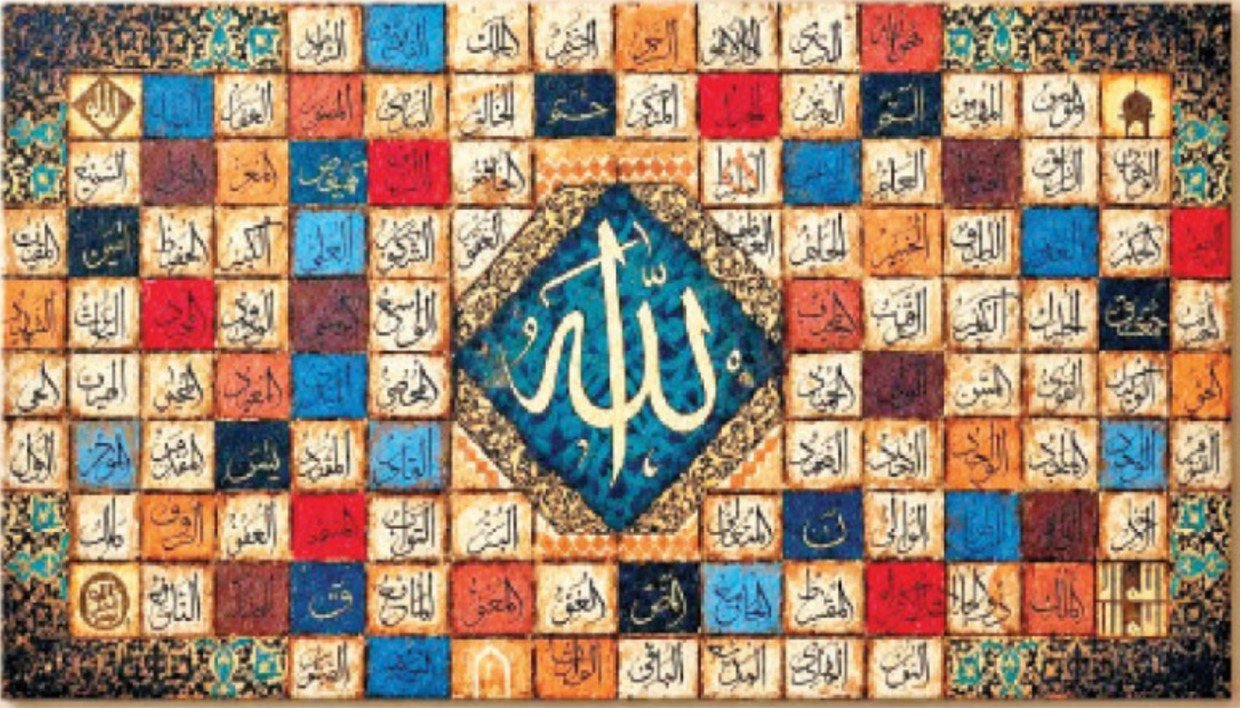
Allah the Almighty possesses countless attributes and glories. These attributes are revealed through beautiful names that befit His sacred Essence. Allah Himself has chosen these names, which are mentioned in the Holy Quran and the Hadith of the Messenger of Allah (peace be upon him).
In the Quran, these names of Allah are referred to as ‘Al-Asma al-Husna’—the most excellent and beautiful names. This subject is addressed in four verses of the Holy Quran. In Surah Al-A’raf, Allah the Almighty states: “And to Allah belong the most beautiful names, so call upon Him by them.”
(Surah Al-A’raf, Verse: 180)
Furthermore, the beautiful names of Allah are also mentioned in Surah Al-Isra (17:110) and Surah Al-Hashr (59:22).
The Hadith highlights the special virtues associated with the 99 names of Allah. There is immense importance in understanding the meanings of these names, memorizing them, preserving them, and grasping their significance in one’s life. It is narrated by Abu Hurairah (may Allah be pleased with him) that the Messenger of Allah (peace be upon him) said: “Allah has 99 names; whoever preserves them will enter Paradise.”
(Sahih al-Bukhari, Hadith: 2736)
Another narration states that whoever enumerates these names of Allah and masters them appropriately is given the glad tidings of Paradise.
Differences of Opinion Regarding the List of the 99 Names of Allah
While the virtues of the 99 names of Allah are mentioned in the Hadith, lists of these names can also be found in various Hadith collections. Although a specific list of the 99 names is not provided in Sahih al-Bukhari or Sahih Muslim, such lists have been compiled in several other Hadith collections, including Sunan Ibn Majah, Sunan al-Tirmidhi, and Al-Mustadrak. However, there are some discrepancies among the lists found in various texts. Consequently, there has been discussion and disagreement among scholars regarding which list is the most acceptable. Hafiz Ibn Hajar al-Asqalani (may Allah have mercy on him) adopted the list narrated by Imam al-Tirmidhi.
Presented below is that list, along with the meanings:
The 99 Beautiful Names of Allah and Their Meanings
He is Allah, besides Whom there is no god.
- Ar-Rahman — The Most Gracious.
- Ar-Rahim — The Most Merciful.
- Al-Malik — The Sovereign/King.
- Al-Quddus — The Most Holy/Pure.
- As-Salam — The Source of Peace/Flawless.
- Al-Mu’min — The Granter of Security/Faith.
- Al-Muhaymin — The Guardian/Protector.
- Al-‘Aziz — The Almighty/Exalted in Might.
- Al-Jabbar — The Compeller/Restorer.
- Al-Mutakabbir — The Possessor of Majesty/Greatness.
- Al-Khaliq — The Creator.
- Al-Bari’ — The Originator/Maker.
- Al-Musawwir — The Fashioner/Shaper.
- Al-Ghaffar — The Oft-Forgiving.
- Al-Qahhar — The Subduer/All-Conquering.
- Al-Wahhab — The Bestower.
- Ar-Razzaq — The Provider/Sustainer.
- Al-Fattah — The Opener/Judge.
- Al-‘Alim — The All-Knowing.
- Al-Qabid — The Withholder/Constrictor.
- Al-Basit — The Expander.
- Al-Khafid — The Abaser/Lowerer.
- Ar-Rafi’ — The Exalter/Elevator.
- Al-Mu’izz — The Honorer.
- Al-Muzill — The Humiliator.
- As-Sami — The All-Hearing.
- Al-Basir — The All-Seeing.
- Al-Hakam — The Ultimate Judge.
- Al-‘Adl — The Just.
- Al-Latif — The Subtle, the Most Kind.
- Al-Khabir — The All-Aware.
- Al-Halim — The Most Forbearing.
- Al-‘Azim — The Magnificent.
- Al-Ghafur — The Most Forgiving.
- Ash-Shakur — The Appreciative (Rewarder of good deeds).
- Al-‘Ali — The Most High.
- Al-Kabir — The Greatest, the Grand.
- Al-Hafiz — The Preserver.
- Al-Muqit — The Sustainer (Provider of nourishment and strength).
- Al-Hasib — The Reckoner (The One who suffices).
- Al-Jalil — The Majestic.
- Al-Karim — The Most Generous.
- Ar-Raqib — The Ever-Watchful.
- Al-Mujib — The Responder (to prayers/supplications).
- Al-Wasi’ — The All-Encompassing (The Boundless).
- Al-Hakim — The All-Wise.
- Al-Wadud — The Most Loving.
- Al-Majid — The Most Glorious.
- Al-Ba’ith — The Resurrector.
- Ash-Shahid — The All-Witnessing.
- Al-Haqq — The Absolute Truth.
- Al-Wakil — The Disposer of Affairs (The Reliable Guardian).
- Al-Qawi — The All-Powerful.
- Al-Matin — The Possessor of Firm Strength.
- Al-Wali — The Guardian and Helper.
- Al-Hamid — The One deserving of all praise.
- Al-Muhsi — The One who keeps account of all things.
- Al-Mubdi — The Originator (the One who brings into existence for the first time).
- Al-Mu’id — The Restorer (the One who brings into existence again).
- Al-Muhyi — The Giver of life.
- Al-Mumit — The Giver of death.
- Al-Hayy — The Ever-Living.
- Al-Qayyum — The Self-Subsisting, the Sustainer and Upholder of all things.
- Al-Wajid — The All-Finding (the One who lacks nothing and possesses everything).
- Al-Majid — The Most Glorious (the One of supreme majesty).
- Al-Wahid — The One (the Unique).
- Al-Ahad — The One and Only (the One who has no equal or partner).
- As-Samad — The Eternal Refuge (the One who is independent of all and upon whom all depend).
- Al-Qadir — The All-Powerful.
- Al-Muqtadir — The Possessor of absolute power.
- Al-Muqaddim — The One who brings forward (the Advancer).
- Al-Mu’akhkhir — The One who puts back (the Delayer).
- Al-Awwal — The First.
- Al-Akhir — The Last.
- Az-Zahir — The Manifest (the Evident and Supreme).
- Al-Batin — The Hidden (the Inward and Unseen).
- Al-Wali — The Possessor of absolute authority (the Guardian/Governor).
- Al-Muta’ali — The Exalted (the One of supreme status).
- Al-Barr — The Source of all goodness (the Beneficent).
- At-Tawwab — The Acceptor of repentance.
- Al-Muntaqim — The Avenger (the One who exacts retribution).
- Al-‘Afuw — The Pardoner (the One who effaces sins).
- Ar-Ra’uf — The Most Kind (the Supremely Affectionate).
- Malikul-Mulk — The Owner of the entire dominion.
- Dhul-Jalali wal-Ikram — The Possessor of Majesty and Honor.
- Al-Muqsit — The Establisher of justice.
- Al-Jami — The Gatherer.
- Al-Ghani — The Self-Sufficient, free from all needs.
- Al-Mughni — The Enricher (the One who removes want).
- Al-Mani — The Preventer (the One who withholds).
- Ad-Darr — The One who has the power to bring about harm.
- An-Nafi — The Bestower of Benefit.
- An-Nur — The Light.
- Al-Hadi — The Guide.
- Al-Badi — The Originator of incomparable creation.
- Al-Baqi — The Everlasting.
- Al-Warith — The Ultimate Inheritor.
- Ar-Rashid — The Guide to the Right Path.
- As-Sabur — The Most Patient.
Source of the list: Sunan al-Tirmidhi, narrated by Abu Hurairah (may Allah be pleased with him); Fath al-Bari, 11/213.
Are there only 99 names of Allah?
There has long been a discussion among Islamic scholars and thinkers regarding the number of Allah’s beautiful names. A significant question, in particular, is whether the names of Allah are limited to just 99, or if there are more.
There are primarily two schools of thought among scholars on this matter.
According to the first view, the number of Allah’s names is limited to 99. Proponents of this view accept the statement found in the hadith narrated by Abu Hurairah (may Allah be pleased with him) literally.
On the other hand, scholars of the second view argue that the names of Allah are not limited to 99; rather, there are many other beautiful names that befit His sacred Essence. They offer several arguments to support this position.
First, there are variations in the lists of names found across different hadith narrations. Since multiple versions of the list of 99 names exist, it is difficult to designate any single list as definitive and universally agreed upon.
Second, some names mentioned in the Quran are absent from the list found in Sunan al-Tirmidhi—for example, Al-Mawla (The Guardian/Protector), Al-Khallaq (The Supreme Creator), and Al-Mudabbir (The Disposer of affairs). Conversely, the list in Sunan al-Tirmidhi includes some names that do not appear explicitly in the Quran. Examples include the names Al-Jalil (The Majestic), Al-Khafid (The Abaser/Lowerer), and Ar-Rashid (The Right Guide).
Furthermore, there are hadith narrations that mention names beyond the 99, such as As-Sayyid (The Great Leader and Master). In one account, when a person addressed the Messenger of Allah (peace be upon him) as “O my leader,” he replied that the true Master is Allah the Almighty. Additionally, names such as Ad-Dayyan, Al-Hannan, and Al-Mannan appear in various narrations.
Prominent scholars who hold the view that Allah’s names are not limited to 99 include Ibn Abbas (may Allah be pleased with him), Fakhruddin ar-Razi, Ibn Kathir, Imam al-Ghazali, Imam al-Qurtubi, and Imam al-Bayhaqi (may Allah have mercy on them).
What is the interpretation of the hadith regarding the 99 names?
If one accepts the view that the number of Allah’s names is not restricted to 99, a question naturally arises: what is the significance of the hadith in which the Messenger of Allah (peace be upon him) mentions 99 names?
Scholars have offered several explanations. One plausible interpretation is that the hadith does not limit the total number of Allah’s names to 99; rather, it highlights the specific virtues of 99 particular names. The hadith states that whoever preserves—or properly learns and internalizes—these names will enter Paradise.
To illustrate this, consider an example: if someone says, “Arif has one thousand dinars set aside for charity,” it does not imply that his total wealth is limited to one thousand dinars. It simply means that a specific portion of his wealth has been allocated for the purpose of charity.
Similarly, the hadith concerning the 99 names of Allah may be understood to mean that, among His countless beautiful names, there are 99 that possess distinct characteristics and specific virtues. For the person who properly masters these names, retains them, and grasps their significance, there is glad tidings of Paradise.
Support for this interpretation can be found in Al-Razi’s work, Sharh Asma’ Allah al-Husna (Beirut, 1984, p. 78).
Are the 99 names specifically identified?
Another perspective on this matter is that among the beautiful names of Allah mentioned in the Holy Quran and the authentic Sunnah, there are 99 names that possess special virtue; however, these specific names have not been explicitly singled out or identified.
According to this view, the total number of Allah’s names mentioned across the Quran and Sunnah exceeds two hundred, yet no definitive list of the 99 names with special virtue has been provided.
This can be compared to the fact that Laylat al-Qadr (the Night of Decree) within the last ten days of Ramadan is not specifically identified, nor is the precise time on Friday when supplications are granted.
There is a profound wisdom behind this: it encourages individuals not to limit their acts of worship or supplication to a few specific names or times, but rather to strive for a broader understanding of all of Allah’s beautiful names and to remain devoted to worship and prayer at all times. This approach not only helps in attaining Allah’s pleasure but also creates opportunities to receive the special virtues associated with these names.
Therefore, the beautiful names of Allah are not merely for rote memorization; it is equally important to comprehend the meaning, significance, and lessons inherent in each name, and to use this understanding when remembering Allah and supplicating to Him. Through Al-Asma’ al-Husna (the Beautiful Names of Allah), one can gain a profound realization of the Almighty’s greatness, power, mercy, wisdom, and infinite attributes.