Desk Report:
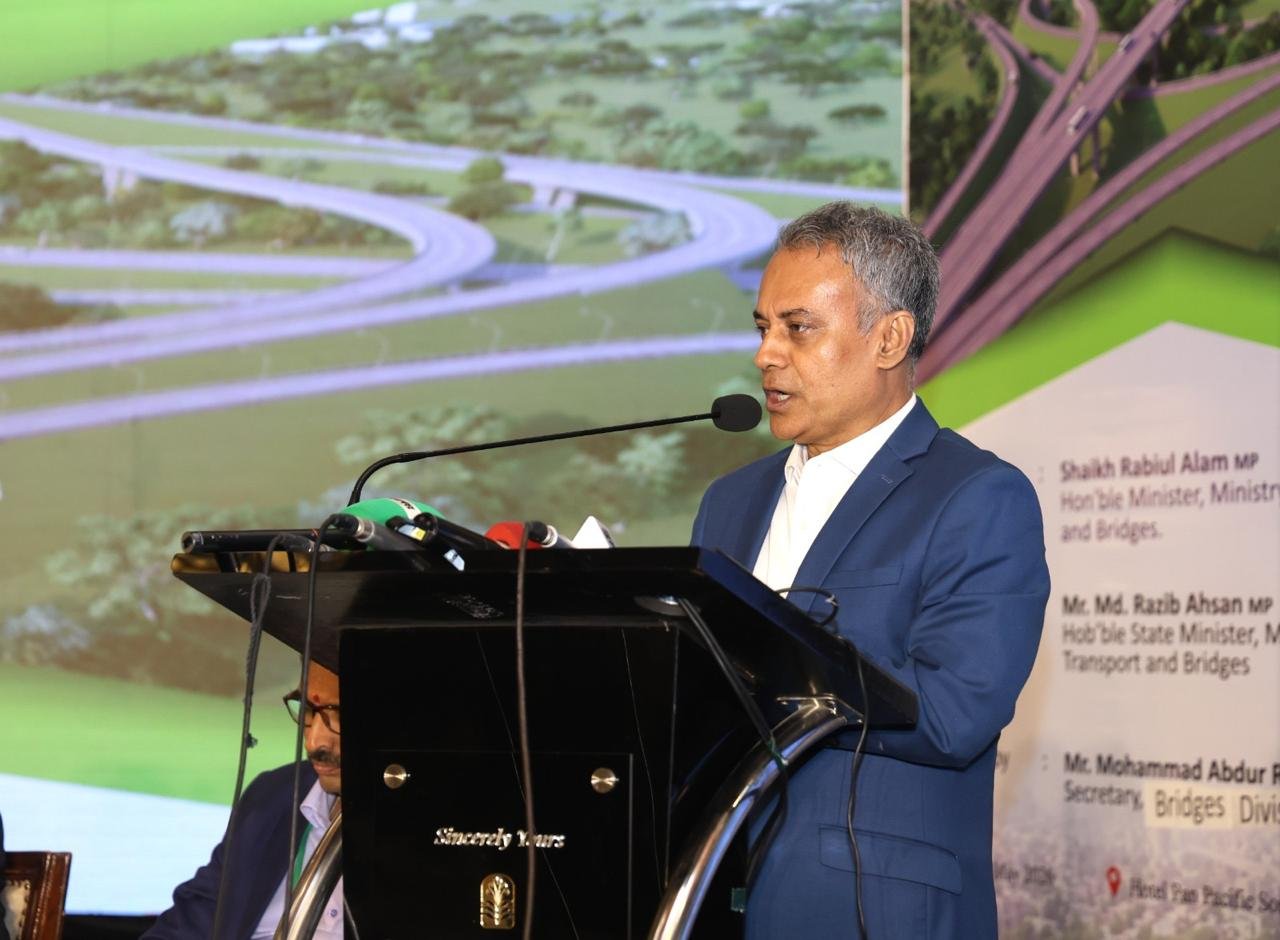
A high-level stakeholder consultation workshop was held at the Pan Pacific Sonargaon Hotel in the capital today (May 5, 2026) to bring about a radical change in the communication system of Dhaka Metropolitan City and its surrounding areas and to resolve traffic congestion, with the aim of constructing the ‘Dhaka East-West Elevated Expressway PPP Project’, one of the government’s priority projects. Honorable Minister of the Ministry of Road Transport and Bridges Sheikh Rabiul Alam MP was present as the chief guest at the workshop. Honorable State Minister of the Ministry of Road Transport and Bridges Mr. Md. Rajib Ahsan MP was present as the special guest at the workshop. The workshop was presided over by Secretary of the Bridge Division and Executive Director of Bangladesh Bridge Authority Mr. Mohammad Abdur Rouf.
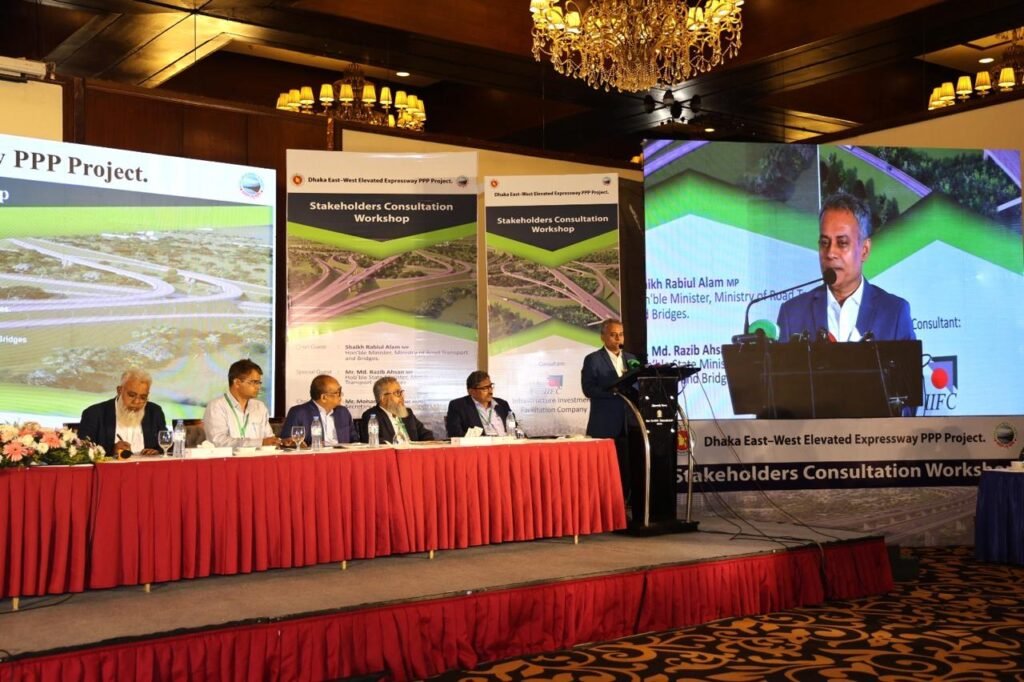
At the beginning of the workshop, Chief Engineer of Bangladesh Bridge Authority and Project Director of Dhaka East-West Elevated Expressway PPP Project Kazi Md. Ferdous highlighted the technical aspects of the project in his welcome speech. Proposed as a groundbreaking step to reduce traffic congestion, this 38.98 km long (N5 to N1) expressway will start from Hemayetpur on Dhaka-Aricha Highway and extend to Langalband on Atibazar, Abdullahpur, Jalparibazar, Narayanganj and Chittagong Highway. 5 main interchanges: N5, Atibazar Road, N8, R111 and N10. 2 major rivers – Buriganga and Shitalakshya will be crossed. Padma Bridge will connect the rail link and Dhaka-Narayanganj railway line. It will be spread across 5 upazilas in 2 districts. Considering the possibility of implementing the project on PPP basis, the government organization Infrastructure Investment Facilitation Company (IIFC) was appointed on 24 December 2024 to update the construction cost and related information of the project as a transaction advisor at the current market rate. On 08 December 2021, the Cabinet Committee on Economic Affairs (CCEA) approved the policy decision to implement the project on Public-Private Partnership (PPP) basis. Today’s workshop mainly received and reviewed the views of all the stakeholders concerned on the updated feasibility study report prepared by IIFC.
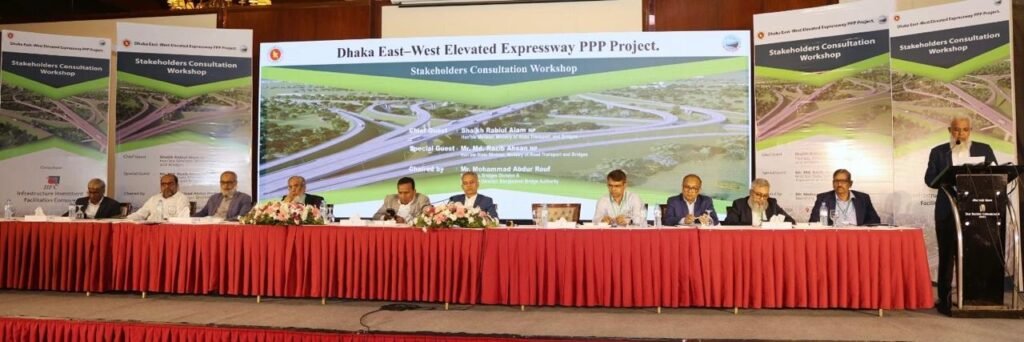
In his speech as the chief guest, Honorable Minister Sheikh Rabiul Alam MP said that this 39-kilometer long expressway will bypass Dhaka and connect Narayanganj from Hemayetpur, thereby establishing communication between the south-western region of the country and the eastern region. This will increase the speed of vehicle movement in Dhaka and reduce traffic congestion by about half. Updated feasibility studies have already been completed. This project, when completed, will radically change our country’s communication system. But there are many complaints about its protracted nature and waste of money. We have wasted a lot of money on the Dhaka-Sylhet Highway for land acquisition. Land acquisition was not done on time. If the project is not implemented on time, it becomes an economic burden. Commitment is needed for these changes. Planning is also needed, he said.
He also said that we want to get out of the 53-year-old state practice of infrastructure construction. We do not want to take up mega projects indiscriminately like the previous government without self-correction and setting goals. We want to spend money in such a way that there is no waste of money and the people benefit. He said in reference to the election manifesto, the current government discourages unnecessary projects, but whatever is needed, be it medium, small, or big, will be done. Although this project is very necessary, its implementation is flawed, we have to work together to make it error-free.
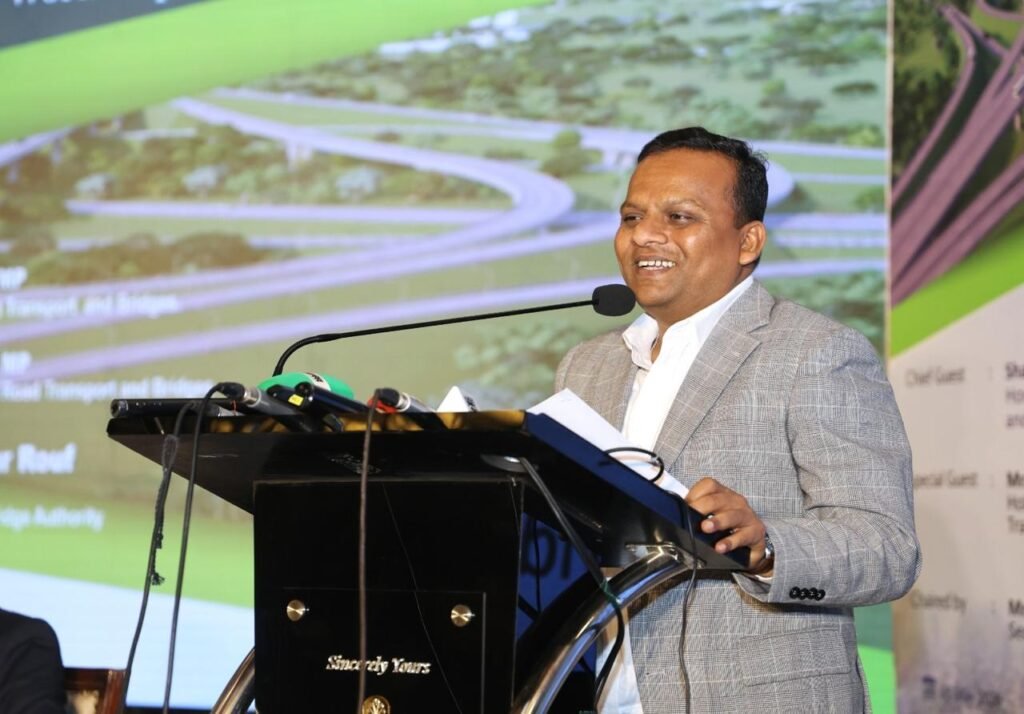
Speaking as a special guest at the workshop, Honorable State Minister for Road Transport and Bridges, Mr. Md. Rajib Ahsan MP said, “Traffic congestion is hampering energy and productivity. Now a modern expressway system is the need of the hour. That is why the government has taken this measure. It will save time, increase the speed of vehicles. It will play an important role especially in goods transport and intercity transport. Financial analysis says that if a realistic toll structure is built, the project will be a groundbreaking step in reality. We want to do the project in a private public partnership, which will be a milestone.
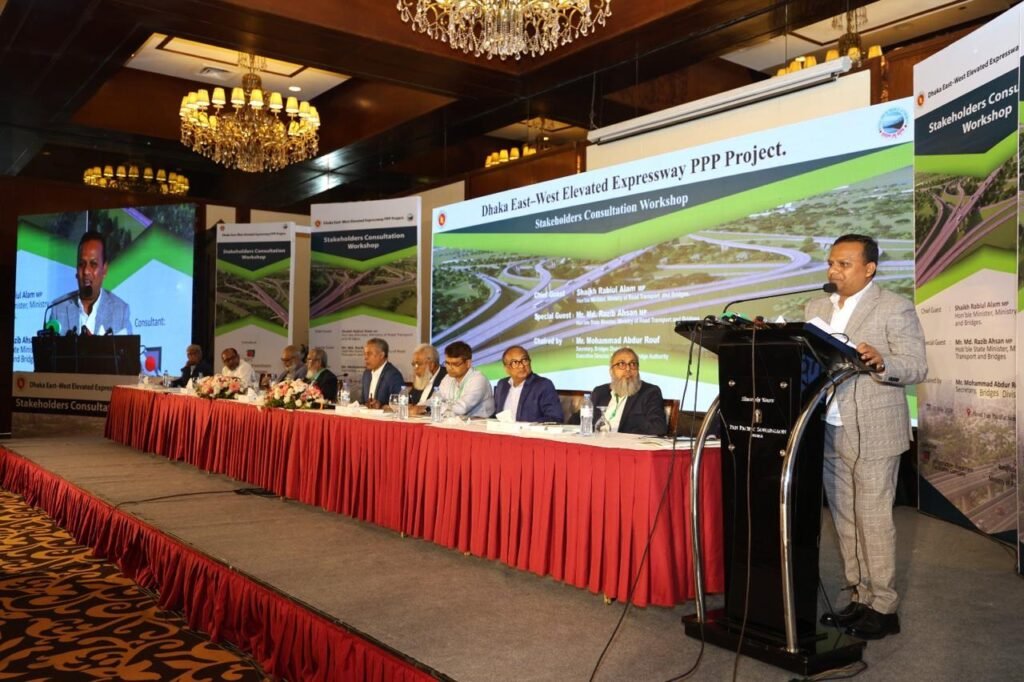
He told the project stakeholders that land acquisition should be done in the shortest possible time. We want to get out of the idea that big projects mean big corruption. We want to take up more such projects, but the implementation process should be free from controversy. Previous projects have created controversy from the beginning. Our tireless work does not come before the people, but controversy comes before it. In any future project, these perspectives of people must be changed. We want to take this sector forward without controversy with everyone. There is a delay in the implementation of projects. One of the reasons for this delay is land acquisition. He also said that the time and cost of the project increases due to land acquisition.
Mr. Mohammad Abdur Rouf, Secretary of the Bridges Division and Executive Director of Bangladesh Bridges Authority, said, the Honorable Prime Minister has kindly given instructions to take necessary measures to modernize the communication system of the entire country. He mentioned that this expressway is not just a road, it will be an economic lifeline. The project will be implemented completely free from controversy and within the stipulated time. If the project is implemented, business and trade will expand and both time and energy will be saved. Above all, we will build Bangladesh as a country.
The expressway project will be constructed by connecting Highway N5 (Dhaka-Aricha), Highway N8 (Dhaka-Mawa) and Highway N1 (Dhaka-Chittagong) through intersections. If the project is implemented, vehicles from the eastern and southwestern districts will be able to travel directly to the aforementioned districts through the expressway to be built without entering Dhaka city through Hanif Flyover. If the expressway project is implemented, vehicles from the eastern and southwestern regions, including Chittagong-Sylhet, as well as Khulna and Barisal, will be able to travel directly to 20 districts in the northwestern region without entering Dhaka city. It will also be connected to the Asian Highway. As a result, traffic congestion in Dhaka and its surrounding areas will be reduced to a large extent.
The total project cost, excluding contingencies and ancillary costs, has been set at Tk 22,000 crore (US$ 2.88 billion), including construction costs of Tk 14,000 crore and land acquisition and resettlement costs. According to a traffic survey conducted in 2025, the number of daily vehicles will be between 21,000-25,000+ in 2030 and may exceed 50,000+ in 2050. If the expressway is implemented, the average speed of vehicles will be about 90 km/h from 20/30 km/h. As a result, the travel time will be significantly reduced.
The economic evaluation of the project has been done using the Social Cost-Benefit Analysis (SCBA) method, where the situation with and without the project has been compared. The project EIRR: 16.42%. The financial analysis of the project has been done through the Base Case Model (based on traffic, toll, cost and financing structure). The project FIRR is 7.66% assuming base toll: BDT 9.20/km and 30% VGF. It is possible to make the project financially sustainable and investable through a combination of appropriate VGF support and realistic toll structure. Therefore, the suggestions given by various stakeholders in this meeting should be integrated and coordinated with various organizations to take this work forward.
Representatives of IIFC presented their detailed power point presentation in the workshop. In the open discussion, various government agencies, development partners and expert stakeholders provided their valuable constructive suggestions. The workshop was attended by the esteemed members of the Panel of Experts, senior officials of the Bridges Division and Bangladesh Bridges Authority and relevant experts.