Business Desk:
The Bangladesh Textile Mills Association (BTMA) has announced that all textile mills will remain closed indefinitely from February 1 due to the government’s ‘lack of effective steps’ to protect the country’s yarn-producing mills.
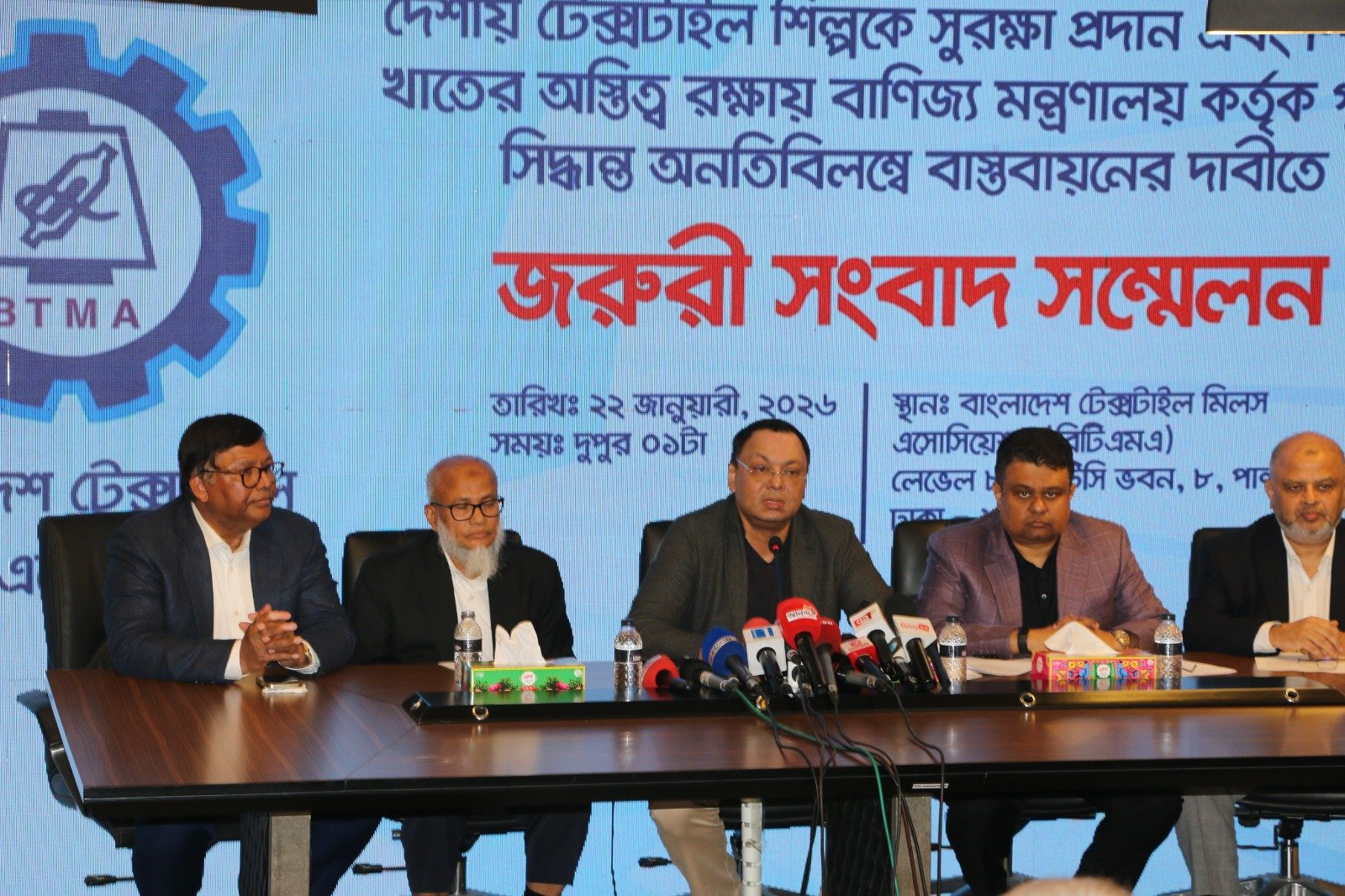
The organization’s president, Shawkat Aziz Russell, made the announcement at a press conference held at the BTMA office in the capital’s Karwan Bazar on Thursday (January 22). Senior leaders of the organization were also present at the time.
The BTMA president said at the press conference, ‘The factories will be closed from the 1st. We will close them, but we do not have the capacity to return the bank’s money.’
The Bangladesh Textile Mills Association (BTMA) has demanded the immediate implementation of the decision taken by the Commerce Ministry to protect the domestic textile industry and preserve the existence of the spinning sector.
Speaking at the press conference, BTMA President Shawkat Aziz Russell said that the country’s primary textile sector has been going through a multifaceted crisis for a long time. Severe misuse of bond facilities, abnormal increase in gas and electricity prices, bank interest rates rising to 16 percent, reduction in cash incentives for exports and working capital crisis due to depreciation of the taka – all of which have put the industry in an existential crisis.
He said that taking these realities into consideration, the Bangladesh Trade and Tariff Commission, after discussions with the relevant stakeholders, recommended the withdrawal of bond facilities for the import of 10-30 count cotton yarn under HS Heading 52.05, 52.06 and 52.07 of the Bangladesh Customs Tariff. Although the Commerce Ministry sent the recommendation to the National Board of Revenue (NBR), it has not been implemented yet, which is very worrying.
The BTMA President said that currently duty-free yarn is being imported from various countries, including neighboring countries, through misuse of bond facilities. As a result, domestic mills are facing extreme losses. About 60 spinning mills have already closed, and those that are operational are also running at an average of 50 percent capacity. Currently, yarn worth about Tk 12,500 crore is lying unsold.
He further said that BTMA is the largest organization in the country’s primary textile sector. It has 1,869 member mills, which include spinning, weaving and dyeing-printing-finishing mills. The investment in this sector is about US $ 23 billion, which is the single largest investment in the private sector. About 85 percent of the country’s total export earnings come from the textile and apparel sector, of which about 70 percent is supplied by BTMA member mills.
At the press conference, he called the recent statements of some entrepreneurs in the ready-made garment sector “false and misleading” and said that the Ministry of Commerce’s recommendation does not propose any new tariffs or safeguard duties. Only yarns that can be 100 percent produced domestically have been proposed to be kept out of the bond facility.
He warned that if this crisis continues, the banking sector will be at serious risk, defaulted loans will increase, and the livelihoods of about 2.5 million workers directly working in the primary textile sector and about 10 million people indirectly dependent on them will be threatened.
The BTMA President also said that in order to maintain duty-free benefits in exports after the upcoming LDC transition, 40-50 percent local value addition must be ensured. If the domestic spinning industry is weak, the garment sector will become completely import-dependent in the future, which will be seriously detrimental to export competitiveness, lead time, and foreign exchange reserves.
From the press conference, he met with Professor Dr., Chief Advisor to the Interim Government. Muhammad Yunus called on the relevant policymakers, including the Prime Minister, to immediately implement the decision to withdraw the bond facility on the import of 10-30 count cotton yarn in the interest of protecting domestic industry, investment and employment.