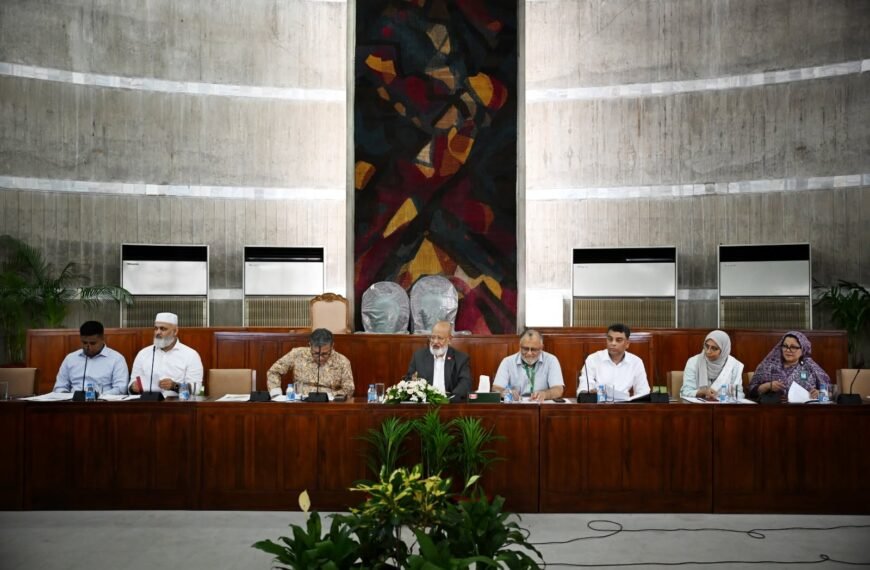
The three-day international conference ‘Bay of Bengal Conversation 2025’ began today, Saturday (22 November 2025), at the Pan Pacific Sonargaon Hotel in Dhaka, organized by the Centre for Governance Studies (CGS). Now in its fourth edition, the conference opened with the PLENARY SESSION titled “Beyond Non-Alignment, The Bay as the New Middle Ground,” where Michael Miller, Ambassador and Head of Delegation of the European Union to Bangladesh, delivered a keynote address.
In his speech, Miller highlighted the growing turbulence in global politics, noting that multilateralism is no longer a luxury but the only viable path to security, sustainable development, and shared prosperity. Despite immense pressure on the rules-based international order, he said the European Union remains committed to strengthening the United Nations system. The EU represents only 5.5% of the global population and 14.7% of global GDP, yet contributes 30.9% of global humanitarian aid and 43% of official development assistance—figures that will rise further in 2025, he added.
Speaking about the Indo-Pacific, Miller noted that the region is becoming increasingly influential in shaping global order. The EU’s approach, he said, is rooted in responsible cooperation, fair trade, secure supply chains, and strong connectivity—values reaffirmed during last week’s Indo-Pacific Ministerial in Brussels, attended by over 70 countries and regional organizations.
Turning to Bangladesh, the Ambassador emphasized that the European Union’s partnership with Bangladesh is a strategic choice, guided by shared priorities such as human rights, economic opportunity, and democratic governance. Over the past 25 years, EU preferential market access has significantly contributed to Bangladesh’s remarkable progress in the ready-made garments sector, creating millions of jobs, empowering women, and supporting the country’s development journey.
Miller confirmed that Bangladesh and the EU are close to finalizing a new, upgraded Partnership and Cooperation Agreement (PCA), which will broaden cooperation across multiple sectors. He reiterated the EU’s continued support for Bangladesh’s democratic transition under the interim government, including technical cooperation with the Election Commission and the deployment of the largest EU election observation mission for the upcoming national polls.
He stressed that whichever party forms the next government, it must continue the reform process, uphold political consensus reflected in the national referendum, and ensure a level playing field for businesses. “Do not take the European Union for granted,” Miller cautioned. “We respect your interests, and we expect the same in return.”
Concluding his remarks, he reaffirmed that despite global rivalries and realignments, the European Union remains committed to deepening its partnership with Bangladesh—one built not only on shared interests but also on shared values, which he said were clearly reflected in the popular movements that shaped Bangladesh’s political landscape in 2024 and 2025. He wished the conference a productive and successful outcome.