Desk Report:
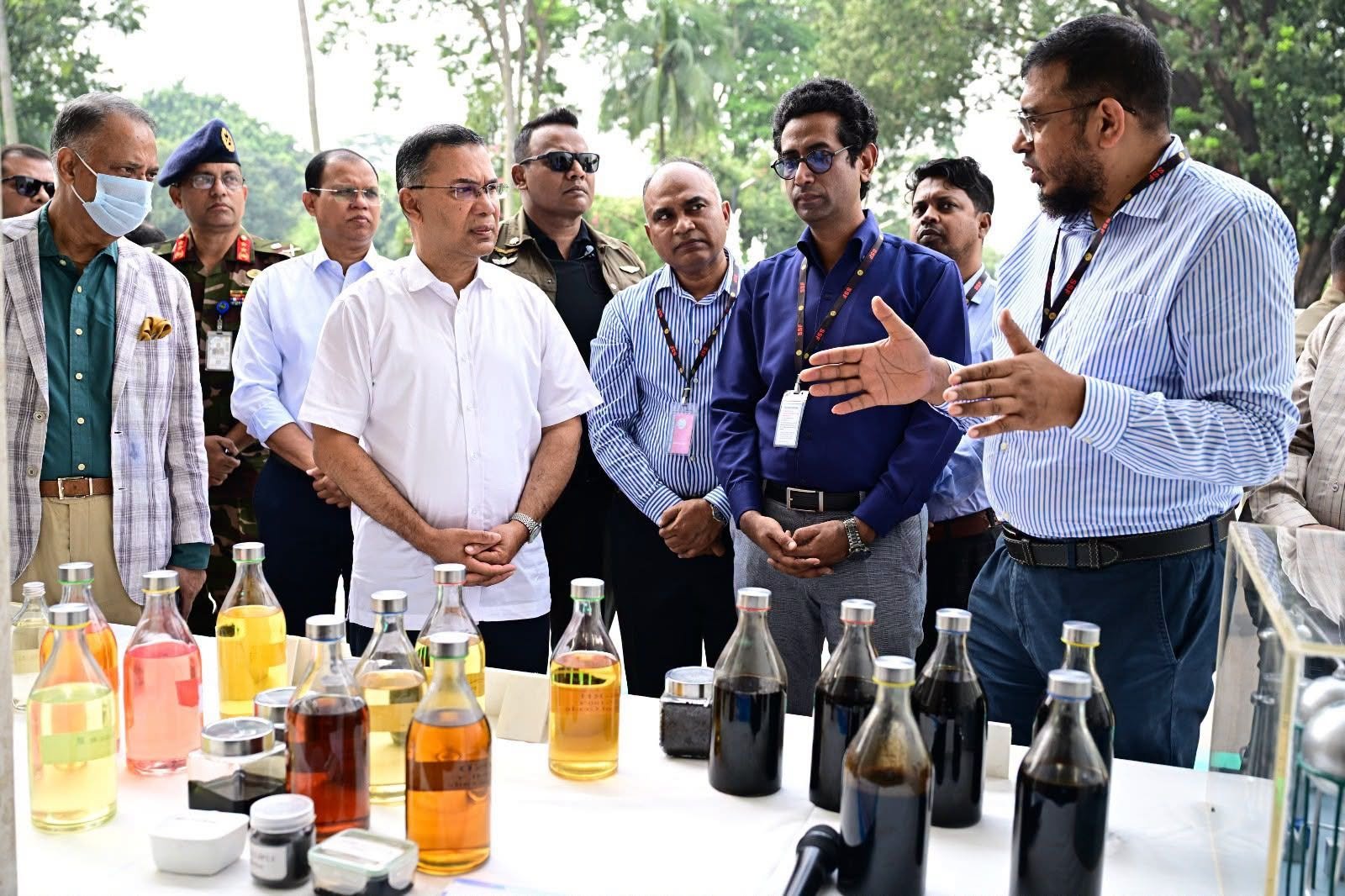
Prime Minister Tarique Rahman visited an exhibition showcasing a project led by researchers from Khulna University of Engineering & Technology (KUET) regarding innovative technology for producing fuel oil from human waste, kitchen waste, and agricultural residues. He assured the government’s full cooperation for the commercial implementation of the project.
The exhibition was held on Saturday morning (October 10, 2026) at the Prime Minister’s Office in Tejgaon, Dhaka. During the event, KUET researchers presented their developed technology, the progress of their long-term research, and the commercial potential of producing fuel oil from waste in Bangladesh.
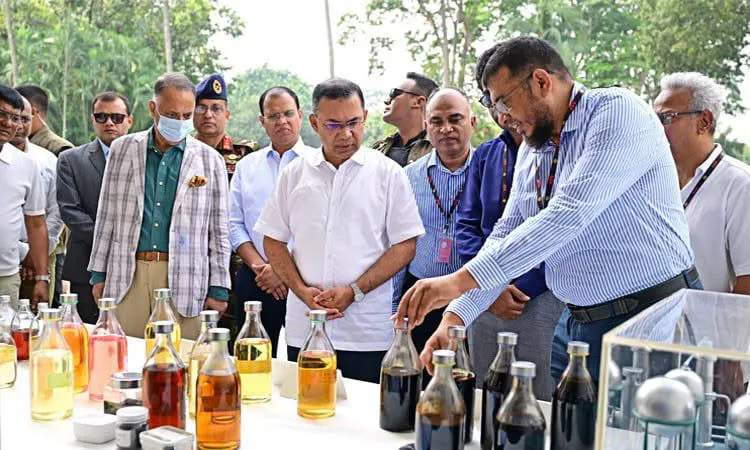
Project researcher and KUET Professor Dr. Md. Khalekuzzaman briefed the Prime Minister on the technology used to produce bio-crude (organic crude oil) from human waste, sewage sludge, kitchen waste, and agricultural residues. The Prime Minister inquired in detail about the project’s operations, implementation plan, and potential benefits, assuring support for its commercial expansion.
According to the researchers, significant progress has been made in producing bio-crude from waste using ‘Hydrothermal Liquefaction’ (HTL) technology over the course of nearly ten years of research. Laboratory tests have yielded bio-crude production rates of 50 to 55 percent. Success has also been achieved in producing diesel-rich bio-crude.
100–120 Crore Taka Required to Set Up Pilot Plant
The next phase of the research involves plans to establish a pilot plant capable of processing one to three tons of waste daily. This plant will be used to evaluate the technology’s effectiveness, production costs, and potential for large-scale commercial application. Researchers estimate that implementing the proposed pilot project will require between 100 and 120 crore Taka.
Researchers believe that if the technology can be successfully scaled up to a commercial level, this fuel could eventually substitute approximately 10 to 15 percent of imported crude oil. This holds the potential to save foreign currency equivalent to an estimated 6,500 to 13,000 crore Taka annually.
However, data from the study indicates that realizing this potential requires a thorough assessment of the technology’s large-scale efficacy, production costs, and economic viability.
New Prospects for Energy Security and Waste Management
Researchers anticipate that if the project achieves commercial success with government support, it could play a pivotal role in alleviating the strain on the country’s import-dependent energy system while simultaneously addressing waste management and environmental pollution. It could also open up new possibilities for saving foreign currency, effectively utilizing waste, and fostering the growth of the domestic energy industry.
In particular, converting materials such as human waste, kitchen waste, and agricultural residues into fuel feedstock could be a significant addition to the country’s waste management and alternative energy initiatives. However, the actual benefits will depend on the pilot plant’s outcomes, production consistency, and the technology’s economic competitiveness at the commercial level.
The event was attended by Power and Energy Minister Iqbal Mahmud Tuku, State Minister Anindya Islam Amit, University Grants Commission (UGC) Member (Public Management) Professor Abdullah Al Mamun, Khulna University of Engineering & Technology (KUET) Vice-Chancellor Professor Mohammad Masud, and Bangladesh Petroleum Corporation (BPC) Chairman Dr. Mohammad Rafiqul Islam.