Desk Report:
In the history of Islam, Hazrat Uthman ibn Affan (RA) is remembered not only as the third Caliph but also as a successful, astute, and generous businessman. Before assuming the responsibilities of the Caliphate, he was known as one of the most prosperous merchants in Mecca. Alongside his commercial success, he set an exemplary standard for utilizing wealth for the welfare of others.
An examination of Uthman’s (RA) business career highlights key principles such as honesty, trustworthiness, risk management, an understanding of market needs, the social application of wealth, and the integration of ethics with profit-seeking. When analyzed through the lens of modern business and economics, the significance of these traits becomes even more apparent.
Reputation as a Vital Business Asset
Achieving success in business requires more than just capital, goods, or funds. A merchant’s honesty, credibility, and social standing are equally valuable assets. Modern sociologist Pierre Bourdieu, through his concepts of “social capital” and “symbolic capital,” demonstrated that social relationships, status, and prestige can function as tangible assets.
Viewing Uthman’s (RA) business life from this perspective makes the importance of his reputation clear. When customers or partners place their trust in a merchant, the need for suspicion, uncertainty, and excessive verification during transactions diminishes—thereby increasing the likelihood of long-term business relationships.
According to the “Transaction Cost Economics” framework developed by economist Oliver Williamson, the costs incurred in gathering information, verifying details, negotiating, and executing contracts are classified as “transaction costs.”
For an honest and trustworthy merchant, these costs are typically lower. Thus, honesty is not merely a moral virtue; it is a fundamental pillar of business efficiency.
Islamic Ethics as the Foundation of Business
Islam does not prohibit commerce; rather, it mandates that legitimate business activities be grounded in principles of justice, integrity, and mutual consent. Allah the Almighty says:
“O you who believe! Do not consume one another’s wealth unjustly—except through trade based on mutual consent.” (Surah An-Nisa, Verse 29)
This instruction bears a significant resemblance to the concepts of honesty, transparency, and accountability found in modern business ethics. In other words, the success of a business does not depend solely on the amount of profit earned; the manner in which that profit is acquired is equally important.
Expanding Trade to Mitigate Risk
A key business strategy is to avoid concentrating all capital or business activities in a single area. By diversifying operations across various markets and regions, a business can offset losses in one market with earnings from another.
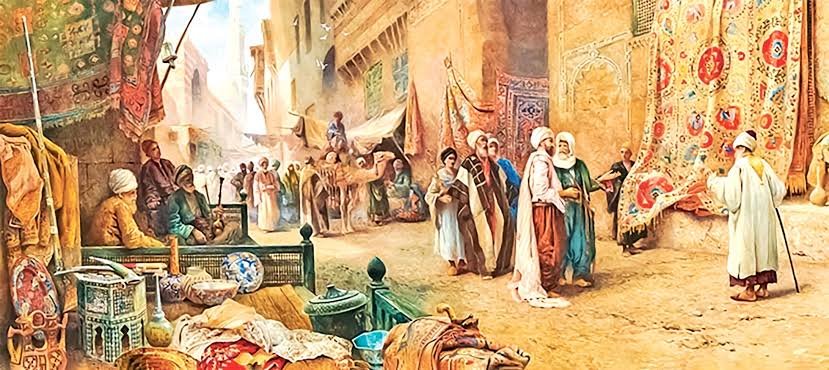
This type of diversification was also evident in the commercial life of the Quraysh. The Quran mentions their trading expeditions:
“For the familiarity of the Quraysh—their familiarity with the winter and summer caravans.”
(Surah Quraysh, Verses 1–2)
By conducting trade with Yemen in the winter and the Levant (Sham) in the summer, they engaged with multiple markets. The modern economic concept of spreading investments across various assets or sectors to reduce risk finds a well-structured explanation in Harry Markowitz’s theory of “portfolio diversification.”
The Quran also encourages human activity in the pursuit of a livelihood:
“And when the prayer has been concluded, disperse within the land and seek from the bounty of Allah.” (Surah Al-Jumu’ah, Verse 10)
Uthman ibn Affan (may Allah be pleased with him) was one of the successful and visionary merchants of the Quraysh. He maintained business connections across various regions, including the Levant (Sham); consequently, his business was not dependent on any single market.
Utilizing Wealth for the Benefit of Others During Crises
One of the most significant characteristics of Uthman’s (may Allah be pleased with him) business life was the social application of his wealth. During a famine in Medina, a large caravan of his, laden with goods, arrived from the Levant. Merchants expressed interest in purchasing his goods and even offered to pay a higher price.
However, as recorded in Muslim tradition, he chose to donate the goods instead, taking into account the needs of the people.
An important point to note here is that, for him, wealth was not merely a means to generate personal profit; it was also a way to address the needs of others. This integration of business success with social responsibility stands out as a significant aspect of his character.
The Ethics of Mudarabah and Partnership
In the early Islamic business system, Mudarabah served as a key model of partnership. In this arrangement, one party provides the capital, while the other contributes labor, expertise, and the responsibility of managing the business. Profits are shared according to a pre-agreed ratio. In the event of a loss, the capital provider bears the financial burden, while the manager forfeits any return for their labor. However, if the loss arises from the manager’s negligence or breach of trust (khiyanat), the liability is handled differently.
At the core of this system lie trustworthiness, confidence, and mutual consent. A Hadith Qudsi states:
“Allah the Almighty says: ‘I am the third partner between two partners, as long as one of them does not betray the other.'” (Abu Dawud)
The Quranic directive is also clear:
“…except that it be a trade by your mutual consent.” (Surah An-Nisa, Verse 29)
In other words, in a partnership-based business, mutual trust and ethical responsibility are just as important as the capital itself.
Understanding Market Demand Without Neglecting Human Needs
According to fundamental economic principles, when the demand for a product rises while its supply remains constant, its price typically increases. Conversely, an increase in supply often leads to a decline in price. Consequently, market demand and supply serve as vital indicators for businesspeople.
When a shortage of goods occurs in one region, it can be profitable for a merchant to source those goods from elsewhere and supply them to the affected area. The practice of capitalizing on price differences for the same product across different markets is known as “arbitrage.”
However, a lesson to be drawn from the life of Uthman (RA) is that the mere existence of an opportunity for maximum profit does not necessitate seizing it. Urgent human needs, social responsibility, and ethical considerations can—and should—also factor into business decisions.
The Incident of the Food Caravan During a Famine
According to an account in the Islamic tradition, a caravan laden with food supplies arrived in Medina during a period of severe food scarcity. Merchants expressed interest in purchasing the goods from Uthman (RA), repeatedly offering higher and higher prices.
Instead of selling the food, however, he chose to distribute it among those in need.
This event is regarded as an example of his immense generosity and his profound trust in Allah. It also holds significance from an economic perspective; it challenges the notion that the sole objective of business should be to maximize profit whenever market demand is high, highlighting instead the importance of social responsibility.
Nevertheless, it would be inaccurate to conclude that Uthman (RA) always based his business decisions solely on an analysis of market demand. Rather, his life offers a lesson on how to integrate ethical values, a sense of responsibility, and humanity with business acumen.
Market Freedom and Human Rights
Islamic economic thought recognizes the importance of the natural, unhindered functioning of markets. Hadith literature mentions an instance where the Companions of the Prophet (PBUH) requested that he set fixed market prices during a period of rising costs. This highlights the importance of a fair pricing system—one that ensures justice without infringing upon individuals’ property or rights.
Conversely, Islamic tradition strongly warns against the artificial creation of shortages—such as by hoarding essential goods—and the exploitation of human suffering for the sake of unjust profit. In other words, Islamic economic policy recognizes the importance of the natural functioning of the market, while simultaneously opposing the unfair manipulation of the market, the creation of artificial crises, and the exploitation of human needs for personal gain.
The Imperative of Fair Dealing
The Quran places significant emphasis on justice and integrity in business transactions. Allah the Almighty states:
“Woe to those who give less [than due]—who, when they take a measure from people, demand full measure, but if they measure out for others or weigh for them, they cause them loss.” (Surah Al-Mutaffifin, verses 1–3)
This passage serves as a warning not only against shortchanging in weights and measures but also conveys a stern message against business fraud, the violation of others’ rights, and dishonesty.
From an Islamic perspective, fair dealing encompasses accurate weights and measures, integrity, justice, the restraint of greed, and empathy toward the needs of others.
The Well of Ruma and the Challenge to Market Monopolies
Another notable example of Uthman’s (may Allah be pleased with him) business foresight is his acquisition of the Well of Ruma in Medina—a vital source of potable water for the local population.
Accounts indicate that, at the time, the well was subject to a form of monopolistic control. Rather than engaging in direct confrontation, Uthman (RA) strategically acquired partial ownership of the well, allowing the public to draw water free of charge on the days designated for his share of usage.
This effectively undermined the existing commercial model governing the well. Historical accounts suggest that Uthman (RA) eventually secured full ownership of the well.
In modern business terminology, this event can be interpreted as an example of fostering market competition, curbing monopolistic influence, and building public trust through the promotion of social welfare.
However, it is more reasonable to analyze the ethical and strategic dimensions of this historical event within a modern context, rather than equating it directly with contemporary business strategies. Wealth, Ethics, and Human Welfare
An analysis of the business life of Uthman (RA) reveals a clear truth: business success and ethics are not mutually exclusive. Honesty builds a merchant’s reputation; a strong reputation fosters long-term trust; and this trust, in turn, strengthens business relationships.
Furthermore, his life demonstrates that wealth is not merely for personal consumption—it can also be utilized to address human needs, navigate crises, and contribute to social welfare.
In the realm of business, factors such as market insight, risk management, diversification, partnerships, and the efficient use of capital are essential. However, business success remains incomplete if it is not grounded in ethics.
Thus, the life of Uthman (RA) presents a holistic approach to business—one where profit exists, yet it is not the sole objective; wealth is present, but it is not the ultimate goal; and while markets exist, the needs of the people remain equally significant.
In essence, the business life of Uthman (RA) serves as a vital paradigm for understanding the interplay between commerce, ethics, and social responsibility in early Islamic society. Modern-day entrepreneurs can draw valuable lessons from his integrity, reputation, business acumen, prudent use of wealth, and dedication to the well-being of others.
His life serves as a reminder that for long-term success in business, economic proficiency must be complemented by credibility, fairness, humanity, and a sense of social responsibility.