Desk Report:
The Civil Aviation Authority of Bangladesh (CAAB) is set to sign a highly anticipated concession agreement tomorrow (November 30) with a Japanese consortium, entrusting them with the operation and maintenance of the Third Terminal at Hazrat Shahjalal International Airport. The agreement will span a period of 15 years. Preparations are underway to commence partial operations at the terminal on December 16—Victory Day—by handling four flights.
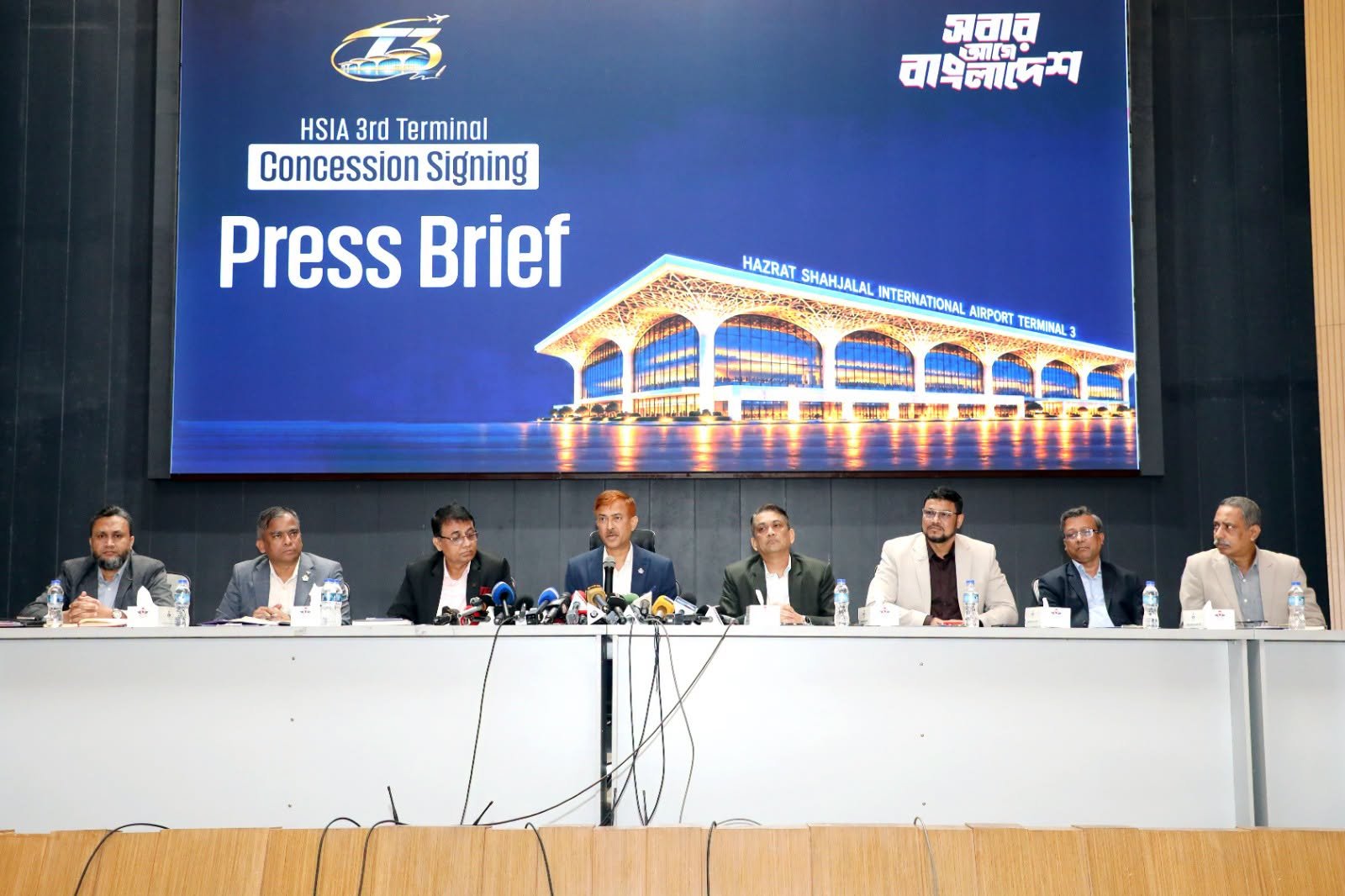
This information was shared by CAAB Chairman, Air Vice Marshal Md. Mostafa Mahmud Siddique, during a press conference held on Sunday (November 29, 2026) at 11:00 AM in the auditorium of the CAAB headquarters. The event was attended by CAAB members, senior officials, and journalists from various media outlets.
During the press conference, the CAAB Chairman stated that the decision to sign this agreement with the Japanese consortium follows extensive discussions, reviews, technical and financial analyses, and the completion of all necessary legal procedures. The agreement prioritizes the protection of national interests, airport security, and the provision of international-standard passenger services.
He further noted that within 15 days of the agreement’s signing, the concession-designated areas of the Third Terminal will be handed over to the operating entity. The objective is to commence services for at least 25 percent of regular international flights within eight months of this handover. Subsequently, the number of flights will be increased in phases, with the goal of transitioning 100 percent of regular international passenger and cargo handling operations to the new terminal within 14 months.
Under the terms of the agreement, the Japanese consortium will—at its own expense—operate, repair, and maintain the Third Terminal, the multi-story car parking facility, and the new import-export cargo terminal. Once full-scale operations begin, passenger services for all regular international flights at the airport will be shifted to the Third Terminal. Meanwhile, the Civil Aviation Authority of Bangladesh (CAAB) will be able to utilize the existing Terminal 1 and Terminal 2 for domestic flights, Hajj flights, and other non-scheduled operations.
CAAB to Receive 27 Percent of Revenue
A key aspect of the agreement concerns revenue sharing. From the commencement date of the designated operations, the operating entity will pay 13.5 percent of the total revenue generated from passenger and cargo sectors to CAAB on a monthly basis. Subsequently, once the terminal reaches its full operational capacity—or by a predetermined date for achieving such capacity, whichever occurs earlier—CAAB’s share of the revenue will increase to 27 percent.
Additionally, the operating entity will derive income from embarkation fees for international departing passengers, boarding bridge usage fees, as well as revenue from terminal retail outlets, lounges, multi-story car parking, and advertising.
The agreement also introduces a new framework for ground handling services. In addition to Biman Bangladesh Airlines, another international ground handling service provider will be engaged. These service providers—as well as entities managing their own ground handling operations—will be required to pay a royalty to the concession-holding operating entity.
Security and State Control Remain with CAAB
Although the responsibility for operating the third terminal has been entrusted to a Japanese consortium, critical control and security-related functions at the airport will remain under the purview of CAAB. CAAB will oversee the management of runways, taxiways, aprons, air traffic control, aviation security, security screening, and fire-fighting and rescue operations.
Meanwhile, functions such as immigration, customs, health screenings, and other state-mandated activities will remain under the control of the respective agencies of the Government of Bangladesh.
The agreement establishes specific standards and Key Performance Indicators (KPIs) to ensure the quality of passenger services. For instance, following the landing of an aircraft, the first piece of passenger luggage must be delivered onto the conveyor belt within 15 minutes. The deadline for the final delivery of baggage has been set at 42.5 minutes for narrow-body aircraft and 47.5 minutes for wide-body aircraft.
Furthermore, standards have been established to limit the average waiting time at check-in counters to between 5 and 10 minutes for business-class passengers, and between 20 and 30 minutes for economy-class passengers.
Critical technical equipment—including the terminal’s baggage handling system, integrated passenger processing system, automated self-check-in kiosks, and flight information display systems—must remain operational 95% to 98% of the time.
Failure to consistently meet the prescribed service standards and performance indicators will render the operating entity liable for financial compensation. Depending on the nature and frequency of such failures, compensation amounts ranging from 5,000 to a maximum of 35,000 US dollars have been stipulated for each instance.
Capacity to serve 24 million passengers annually
Spanning an area of approximately 230,000 square meters, the third terminal has the capacity to serve 24 million passengers per year. It features 127 check-in counters (including self-check-in options), 129 passport control counters, 8 on-arrival visa counters, 10 transit and transfer counters, and 16 airline ticket counters.
Additionally, 16 baggage conveyor belts, 12 contact boarding bridges, and 25 remote aircraft parking bays have been constructed for arriving passengers. Security infrastructure includes 99 baggage X-ray screening machines, 22 body scanners, 55 walk-through metal detectors, and 39 explosive detection systems.
To facilitate passenger movement and comfort, the facility is equipped with moving walkways, escalators, and elevators. A multi-story car parking building has been constructed with a capacity to accommodate 1,230 vehicles.
To enhance cargo handling capacity, an import cargo terminal spanning 27,000 square meters and an export cargo terminal covering 36,000 square meters have been built. Together, these new terminals have an annual cargo handling capacity of 820,411 metric tons—comprising 273,470 metric tons for imports and 546,941 metric tons for exports. It is noted that the commissioning of these new cargo terminals will quadruple the existing cargo handling capacity.
The Chairman of the Civil Aviation Authority of Bangladesh (CAAB) stated that the state-of-the-art technology and passenger-friendly amenities of the third terminal will play a pivotal role in boosting the nation’s aviation capacity, expanding international air connectivity, and fostering growth in tourism, trade, commerce, and investment.
He further emphasized the vital role of the media in the successful launch and overall development of the third terminal. He sought the cooperation of the media and all relevant stakeholders in advancing the country’s aviation sector through objective reporting, constructive suggestions, and the promotion of public awareness.
It is worth noting that the third terminal at Hazrat Shahjalal International Airport is an infrastructure project long-awaited by air travelers in the country. Through the concession agreement, the Civil Aviation Authority of Bangladesh (CAAB) expects to ensure modern management, maintenance, and international-standard passenger services, while simultaneously making Bangladesh’s aviation sector more capable and competitive.