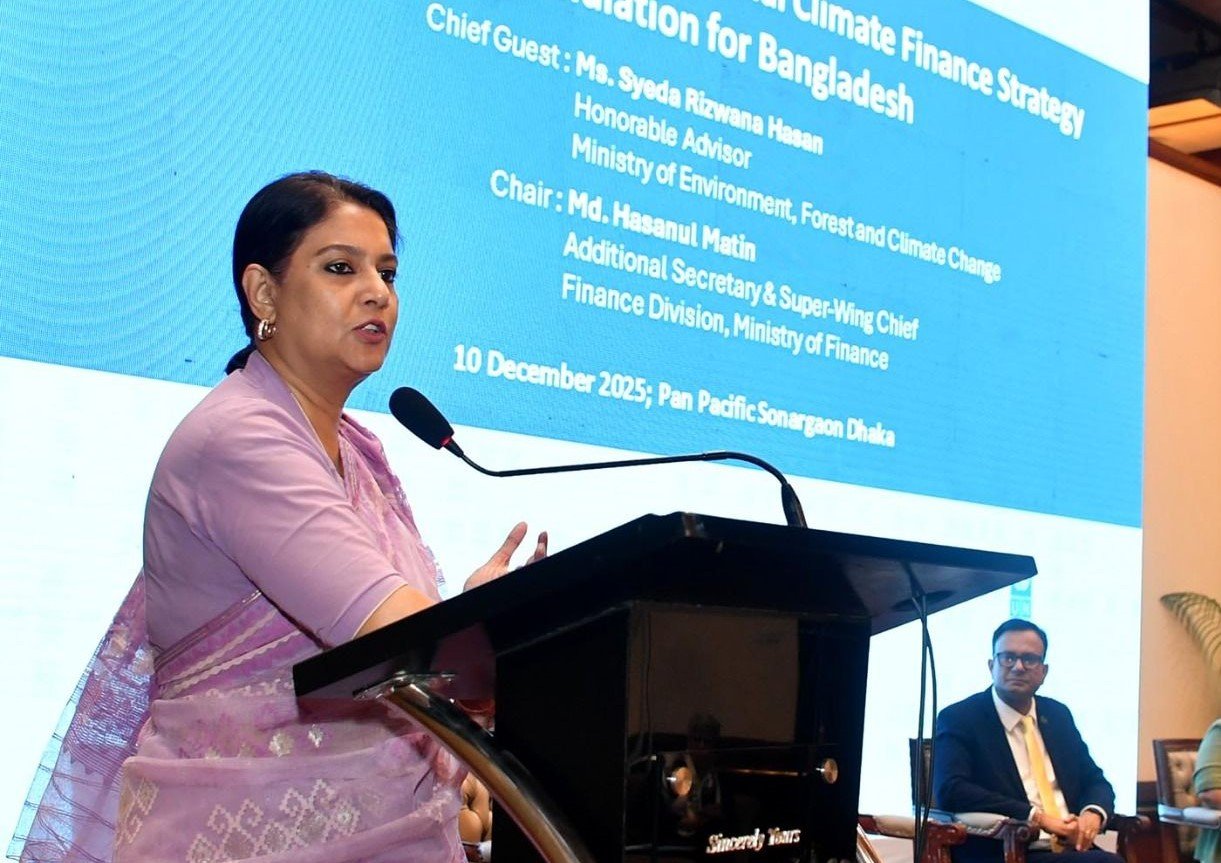
Advisor to the Ministry of Environment, Forests and Climate Change and the Ministry of Water Resources Syeda Rizwana Hasan said that climate finance reform must prioritize the needs of local people, institutional capacity and transparency. “Rapid fund disbursement, proper planning, coordination with international partners and a funding structure capable of protecting vulnerable populations are now essential,” she said.
She made these remarks while addressing the keynote address of a consultative workshop titled “Formulation of Bangladesh’s National Climate Finance Strategy” held at the Pan Pacific Sonargaon Hotel in the capital on Wednesday (December 10, 2025). The workshop was attended by high-level government officials, development partners and climate finance experts.
She recalled that the global climate finance commitment was originally based on the principle of “new and additional” assistance. “Over time, that commitment has waned. Many developed countries responsible for the climate crisis still deny scientific truth. This denial makes climate finance complex and unfair,” he commented. He said that while some countries have kept their promises, many use climate negotiations strategically.
In the domestic context, he highlighted the issue of uneven budget allocation.
He said, “Every year, the Ministry of Environment and Climate Change receives the lowest budget allocation, while large infrastructure projects are prioritized. Adaptation, waste management and local-level resilience do not receive adequate funding.” He also lamented the lack of an effective national waste management system even after 54 years of independence.
He said, “It is not enough to just give money. Organizations must have planning skills, staff capacity and a rapid implementation system. It also takes a long time to publish awareness materials. If the process becomes the goal, the results will suffer.” He called on the Ministry of Finance to simplify the process and ensure transparency.
In the context of the new institutional framework, he highlighted the importance of the Bangladesh Climate Development Partnership (BCDP). He said, “BCDP should be developed as a central coordination platform. Strategic directions should be developed through four working groups—domestic financing, international financing, project development and monitoring.” He said it was important to ensure technical equipment, skilled human resources and a working space for the secretariat in this regard.
He said that the access process to the Bangladesh Climate Change Trust Fund has been restructured and now non-governmental organizations can apply jointly with the relevant ministry or department. “On the one hand, this will give government agencies field experience, while on the other hand, civil society can play a meaningful role in decision-making,” he said.
Highlighting the issue of fair allocation, the advisor said, “In river erosion areas, salinity zones and drought-prone areas, hundreds of applications are received, but only a small amount of support is possible. Investment in protecting vulnerable populations is much more economically fruitful, than building new roads.” He also commented that showing spending in irrelevant sectors—especially defense—as climate finance “undermines accountability and credibility.”
Later, at an event titled “Bangladesh’s Commitment to Ensuring Justice and Rights for All” organized at the capital’s Hotel Intercontinental to mark Human Rights Day 2025, Advisor Rizwana Hasan said the government is determined to ensure justice and human rights. She said that the newly formed Police Commission will now take action on complaints against law enforcement agencies—which was not the case earlier. If the right person leads, this will be a major achievement, she commented.
“We have been able to bring about some structural changes in the police sector. There has also been progress in protecting forest and environmental rights. A lot will depend on how the future leadership will run the country. However, at least with the space that has been created for expression, it will not be as easy to take unilateral decisions as before.” She added that the legal framework is being created and the government’s goal is to move forward with everyone.
Advisor to the Ministry of Law, Justice and Parliamentary Affairs Dr. Asif Nazrul; Advisor to the Ministry of Housing and Public Works Adilur Rahman Khan; Bangladesh Representative of the United Nations Development Programme Stefan Liler and Secretary of the Law and Parliament Division of the Ministry of Law, Justice and Parliamentary Affairs Dr. Hafiz Ahmed Chowdhury were present at the event.