Desk Report:
Home Minister Salahuddin Ahmed stated that Bangladesh is committed to the safe, voluntary, dignified, and sustainable repatriation of Forcibly Displaced Myanmar Nationals (FDMN) to their homeland. Efforts are being intensified to strengthen coordinated regional and international diplomatic initiatives to ensure this outcome.
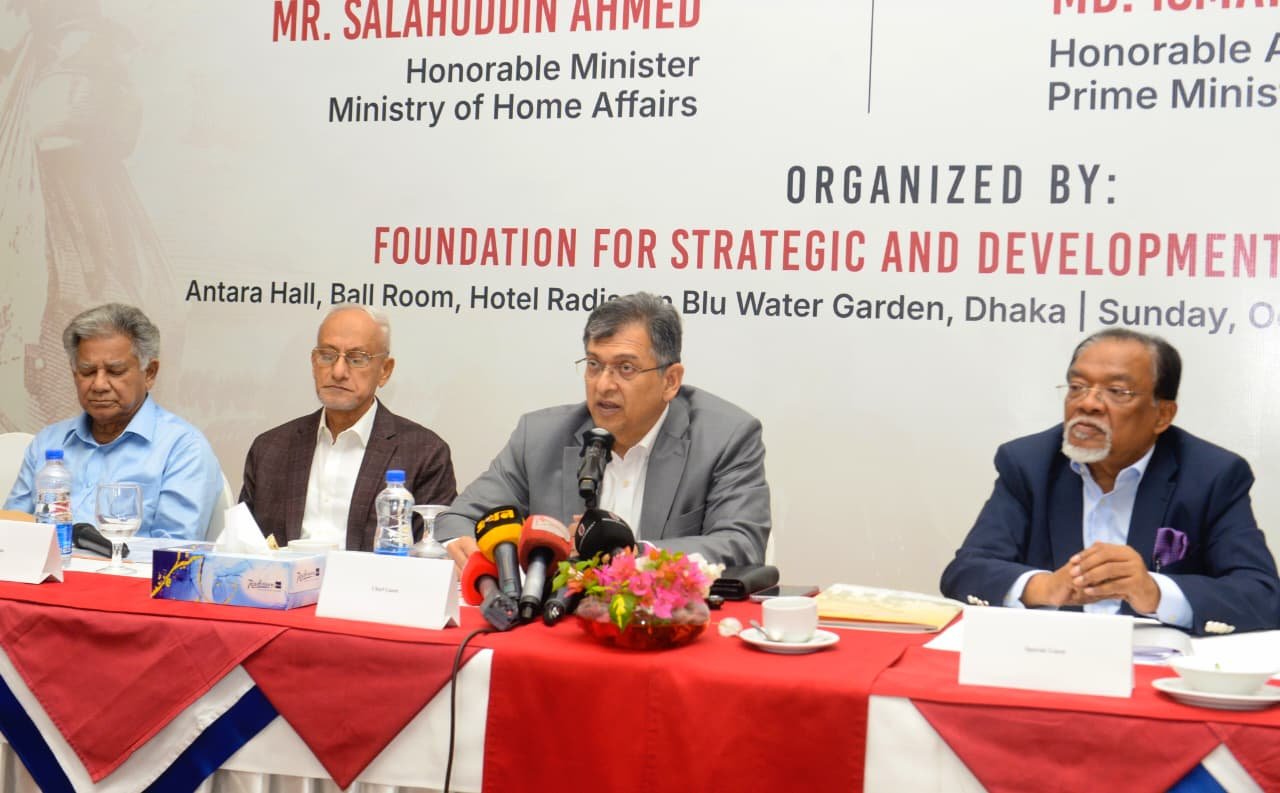
The Minister made these remarks on Sunday (October 11, 2026) while addressing a seminar titled “Rohingya Crisis: Way Forward – Towards Sustainable Repatriation and a Durable Regional Solution” as the chief guest. The event was organized by the ‘Foundation for Strategic and Development Studies’ (FSDS) at the Antara Hall of Hotel Radisson Blu Water Garden in Dhaka.
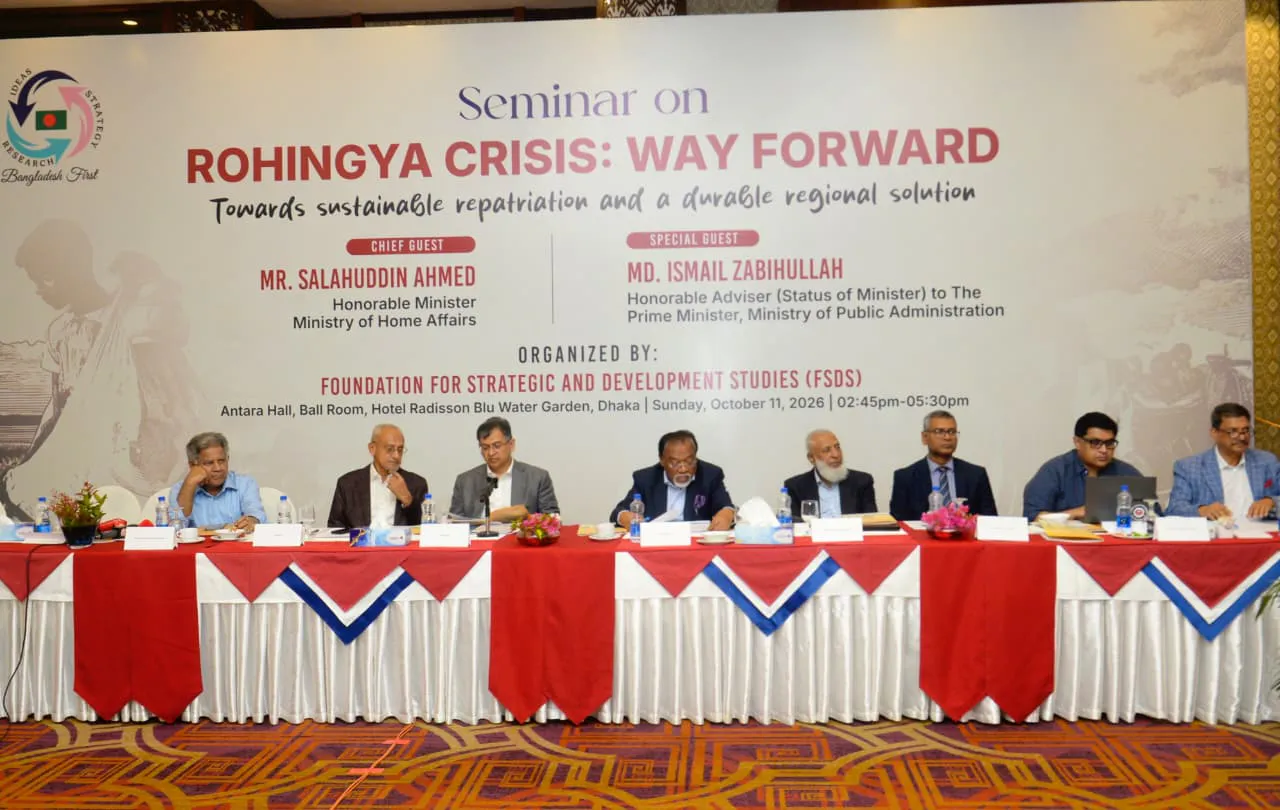
Md. Ismail Zabiullah, the Prime Minister’s Advisor on Public Administration (holding the rank of a Minister), spoke as the special guest at the seminar, which was presided over by FSDS Chairman Major General Fazle Elahi Akbar (Retd.).
In his address as the chief guest, the Home Minister emphasized that Bangladesh’s unilateral efforts alone are insufficient for the sustainable repatriation of displaced Myanmar nationals; rather, it is essential to build a strategic regional alliance and a coordinated approach involving all relevant stakeholders, including China, ASEAN, the United Nations, and Japan.
The Minister noted that Sasakawa—the Japanese government’s Special Envoy for National Reconciliation in Myanmar and Chairman of the Nippon Foundation—recently visited Bangladesh. During the visit, both the Prime Minister and the Minister held detailed discussions with him, and the Japanese government pledged its full cooperation in this matter. Additionally, the Prime Minister is scheduled to visit Japan later this month, where further discussions regarding the acceleration of the repatriation process will take place.
Referring to the evolving geopolitical and security situation in Rakhine State, the Minister observed that, alongside the de jure government, the Arakan Army (AA) currently controls a significant portion of the territory. Consequently, in the current context, avenues for a solution are being explored through various diplomatic channels, including informal communication. However, peaceful repatriation remains the primary objective, and Bangladesh will continue diplomatic dialogue while keeping all options open as a final resort.
Speaking as a special guest, the Adviser on Public Administration stated that the Rohingya crisis is not merely a humanitarian issue or a bilateral matter; it is deeply intertwined with national interests, regional stability, and international geopolitics. Considering the multifaceted complexities of the crisis over the past decade and the shifting political and military landscape in Myanmar, we must now transition from crisis management to strategic diplomacy, from temporary relief assistance to sustainable repatriation, and from fragmented initiatives to a unified national strategy. Furthermore, he emphasized the importance of ensuring the safe and dignified return of the Rohingyas to their homeland by exerting pressure on the international community and Myanmar, alongside upholding their human rights and protection.
Interacting with journalists after the seminar, the Home Minister noted that Bangladesh’s selection to the presidency of the UN General Assembly this year has created an opportunity to present the repatriation issue more forcefully to the international community. He expressed optimism that a path toward rapid and sustainable repatriation could be found through discussions with the international community, supported by neighbors and partners such as China, Japan, India, the United States, and the European Union.
Three significant thematic papers were presented at the seminar. In the first paper, Professor Dr. A. S. M. Ali Ashraf shed light on the political and security landscape amidst the changing realities in Myanmar and Rakhine. The second paper, presented by Professor Shahab Enam Khan, focused on development, connectivity, and repatriation concerning Rakhine. In the third paper, Brigadier General Shafayat Ahmad, PhD (Retd.), put forward important proposals regarding regional diplomacy and Bangladesh’s strategic pathways.
During the discussion on the presented papers, speakers emphasized that repatriation is not merely the physical resettlement of people; Rather, ensuring a conducive environment—encompassing the safety, citizenship, housing, and livelihoods of the returnees, as well as their acceptance by the local community—is the key to a sustainable solution.
Distinguished diplomats from home and abroad, representatives of international organizations, retired military officers, researchers, academics, and representatives from various media outlets attended the seminar.