Desk Report:
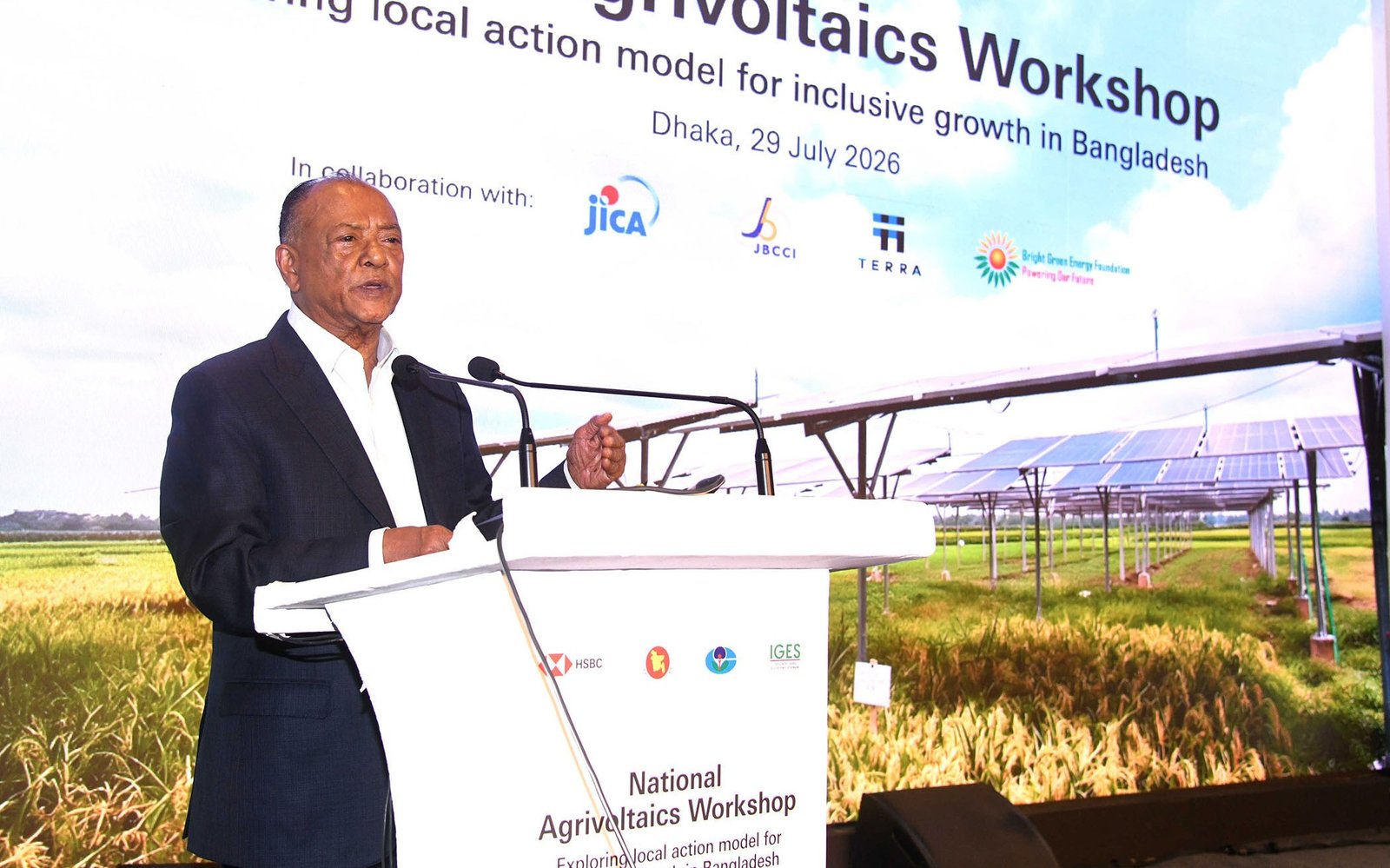
Environment, Forest and Climate Change Minister Abdul Awal Mintoo has said that agrivoltaics can play an important role in expanding renewable energy while continuing agricultural production on the same land. However, food security, farmer rights, environmental protection and fair distribution of benefits must be kept at the heart of every agrivoltaic initiative.
He said these things while addressing the chief guest at the workshop titled ‘National Agrivoltaics Workshop: Exploring Local Action Models for Inclusive Growth in Bangladesh’ held at The Westin Dhaka in the capital on Wednesday (July 29, 2026).
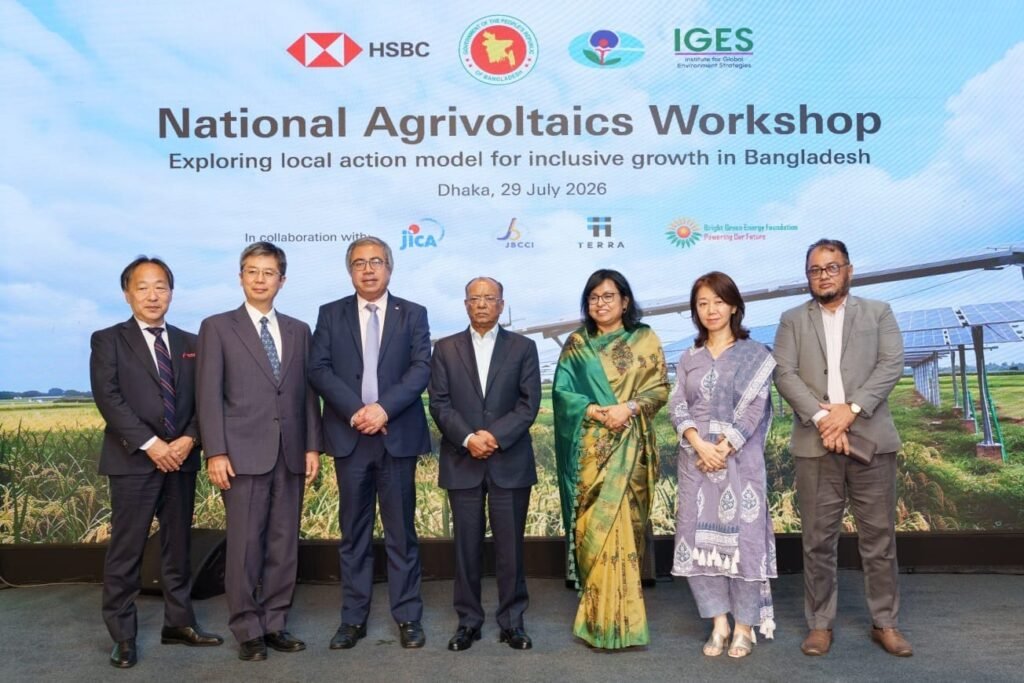
The workshop was organized by the Institute for Global Environmental Strategies (IGES). HSBC Bangladesh, Department of Environment (DoE), TERRA Co., Ltd. of Japan and Bright Green Energy Foundation (BGEF) are collaborating in this. In addition, the Ministry of Environment, Forest and Climate Change, Embassy of Japan in Bangladesh, JICA and Japan-Bangladesh Chamber of Commerce and Industry (JBCCI) are supporting the workshop.
The Environment Minister said, “Our goal is to build a Bangladesh where climate action, food security and economic development complement each other. Agrivoltaics is an effective means to achieve that goal. Through this, it is possible to produce clean energy, increase farmer capacity, conserve agricultural land and move towards a low-carbon and climate resilient future.”
He further said that Agrivoltaics will not only open up new horizons in renewable energy production, but will also help advance food production and energy security together by ensuring the best use of limited land.
The workshop was informed that a pilot project implemented in Manikganj is testing the success of shade-tolerant rice, red leaf and coriander cultivation under high-rise solar panels. Coriander has shown the best results. An integrated model of clean energy and agricultural production by using solar power to irrigate the same land has also been demonstrated. There are also plans to supply surplus electricity to the national grid in the future.
The workshop was chaired by Dr. Fahmida Khanam, Secretary, Ministry of Environment, Forest and Climate Change.
Speaking as a special guest, Naoki Takahashi, Minister and Deputy Chief of Mission of the Embassy of Japan in Bangladesh, reiterated Japan’s commitment to further strengthen its cooperation in the sustainable energy sector in Bangladesh.
Junko Takahashi, Chief Representative of JICA Bangladesh, said that agrivoltaics can serve as an innovative solution for food security, clean energy, sustainable rural livelihoods and poverty alleviation. In this regard, there is an opportunity to further expand Bangladesh-Japan cooperation.
IGES President Professor Kazuhiko Takeuchi said, “Through integrated local initiatives, Bangladesh can establish regional leadership in agrivoltaics for climate action, food security, clean energy and inclusive economic growth.”
Japan-Bangladesh Chamber of Commerce and Industry (JBCCI) President Tarek Rafi Bhuiyan said, “Ensuring clear policies, innovative business models and active participation of farmers will increase private investment in the agrivoltaics sector and strengthen the rural economy along with food and energy security.”
HSBC Bangladesh CEO Md. Mahbub Ur Rahman said, “The company is proud to support the transfer of agrivoltaic technology from Japan to Bangladesh and to demonstrate the integrated use of agriculture and renewable energy on the same land through the pilot project in Manikganj.”
In her closing remarks, Secretary Dr. Fahmida Khanam said that to realize the full potential of agrivoltaics, local farmers need to be at the center of this transformation and involved as active partners.
The workshop highlighted Japan’s experience, public and private sector views, and policy recommendations for Bangladesh. The discussion emphasized ensuring equal benefits for farmers, developing financially sustainable business models, creating rural employment, and strengthening local economies.
The event was attended by representatives from the Ministry of Environment, Forests and Climate Change, the Embassy of Japan, JICA, the Japan-Bangladesh Chamber of Commerce and Industry, research institutions, financial institutions, the private sector, and various development partners.