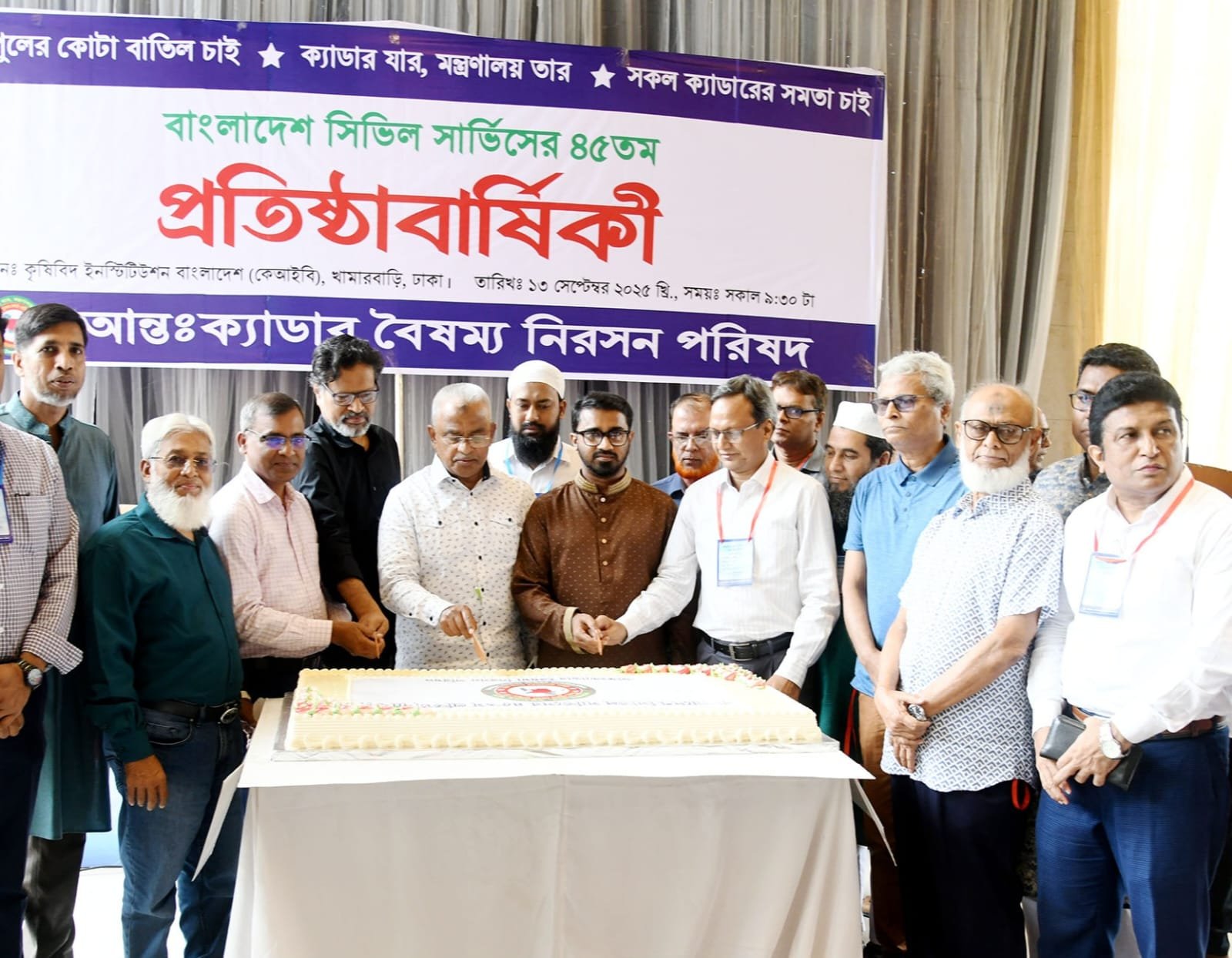
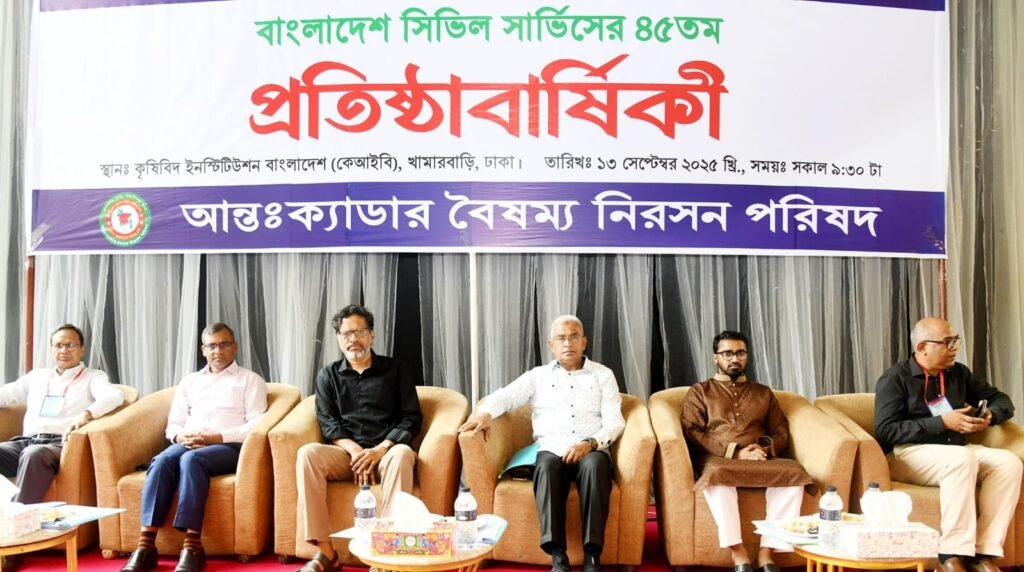
On 1 September 2025, the 45th anniversary of the Bangladesh Civil Service (BCS) was observed. To mark the occasion, the Inter-Cadre Discrimination Elimination Council organized an event at the Krishibid Institution Convention Hall in Farmgate. The programme was attended by serving and former members of the BCS as well as prominent political figures, academics, and distinguished personalities from various walks of life.
Speakers at the event included Advocate Syed Moazzem Hossain Alal, Adviser to the BNP Chairperson; Firoz Ahmed, former member of the Constitution Reform Committee; Dr. Mohammad Golam Rabbani, Professor of History at Jahangirnagar University; Muhammad Rashed Khan, General Secretary of Gono Adhikar Parishad; Md. Elias Matabbor, Organizing Secretary of Bangladesh National Party (BJP); and Agriculturist Iqbal Ahmed Chowdhury, Convener of the Council for the Elimination of Inter-Cadre Discrimination.
Dr. Muhammad Mofizur Rahman and Atiya Sultana presented the keynote papers, which recalled newspaper reports from 2 September 1980 carrying headlines such as “Colonial structure goes,” “No elitist privileges for any BCS cadre,” and “Unified Civil Service Introduced.” They noted that, despite the original vision, one cadre still claims to be the heir of colonial elitism and maintains an exclusivist attitude.
Speakers stated that 14 main cadres and 14 sub-cadres — 28 cadres in total — were integrated to form a professional, ideal-oriented and unified civil service. This system was adopted to ensure equal opportunities for all on the basis of merit, thereby enabling talented officers at every level to contribute to national development by participating in the governance of the country.
They recalled that on 1 September 1980, on the day of the civil service’s formation, then-Minister for Establishment Maj. Gen. (Retd.) Mazedul Haque had said: “1 September 1980 is a memorable day in our nation’s history. Not only in the subcontinent but also within the Commonwealth, we are the first to guarantee equal rights to all based on merit.” Yet, over the past 45 years, no government has ensured equal opportunities for all cadres. Even during the 1991–1996 rule of President Ziaur Rahman’s ideological party, an attempt to implement Zia’s vision failed due to the manoeuvring of one cadre, which instead entrenched autocracy within the civil service to serve its own group interests.
Quoting newspapers, the speakers added that although President Ziaur Rahman had announced a merit-based, quota-free civil service, the subsequent government of Ershad established the DS Pool on a quota basis, sacrificing national interests to the interests of one cadre — a system that persists to this day.
The speakers demanded abolition of all quotas in DS Pool recruitment to establish a merit-based civil service in the interest of the state and its people. They also emphasized the need for professional ministries to ensure professionalism, and urged the government to build an accountable and improved professional service management system that guarantees equal benefits for all. They noted that although the DS Pool was created to utilize the professional expertise of different cadres in their respective ministries, in practice one cadre’s officers are now posted across ministries, undermining the original purpose of the pool. They highlighted that one cadre receives promotions without holding positions, whereas officers from other cadres, even after double the feeder time for the same posts, are denied promotion — a situation they described as discriminatory and arbitrary.
Professor Dr. Golam Rabbani of Jahangirnagar University stated that protests must continue until the demands are met.
Former Administrative Reform Commission member Firoz Ahmed lamented that during the COVID-19 pandemic, expert opinions were ignored and decisions were taken by health secretaries, ministry officials, and businesspeople — leading to predictable disasters. Citing Dr. Akbar Ali Khan’s book, he said that poor bureaucracy has swallowed the entire government system of Bangladesh. He observed that the administration cadre has repeatedly expanded its own power during critical times for the government and the country, and expressed disappointment at the lack of positive, much-needed reforms in the past year.
Gono Adhikar Parishad Secretary Muhammad Rashed Khan said his organization would always stand beside those facing discrimination and called upon the government to take steps to address disparities among cadres. He also stressed the need for collective efforts to rid the country of corruption.
BJP Organizing Secretary Elias Matabbor urged the government to address the grievances of 25 cadres before their anger and agitation turn into revolution. He added that the nation wants to know who brings people with little education into parliament.
Former Director of the Agriculture Cadre Iqbal Ahmed Chowdhury asked if the 2024 revolution and bloodshed had taken place only for the sake of one cadre’s promotions and benefits, and why that one cadre alone continues to enjoy all privileges.
Syed Moazzem Hossain Alal stated that all the benefits of 25 cadres were expanded during the BNP government. He noted that President Ziaur Rahman had declared that there would be no elitism in bureaucracy and had introduced the Deputy Secretary Pool, which was later revitalized under Khaleda Zia’s government.
The event also highlighted the profiles, activities, and achievements of the BCS cadres, and discussed future strategies to improve the development of various cadres and the quality of public service delivery. Speakers said the Council had demanded the establishment of professional ministries, meaning that skilled and experienced officers from respective cadres should be posted in their own ministries. At present, they noted, policy-making, planning, and decision-making in every sector is being done by members of the administration cadre, who are often inexperienced and unskilled in those sectors, resulting in failure to deliver desired public services.
Mohammad Jamilur Rahman, Coordinator of the Inter-Cadre Discrimination Elimination Council and Convener of the Celebration Committee, presided over the event, while Dr. Md. Ahsan Habib, the Council’s Coordinator and Member Secretary of the Celebration Committee, delivered the welcome address.
It was noted that although 1 September was originally decided to be observed as Bangladesh Civil Service Day, it had never been celebrated in this way before. Speakers thanked the Inter-Cadre Discrimination Elimination Council for organizing the observance.
The Council has long been working tirelessly to eliminate entrenched disparities among BCS cadres and to build a people-friendly civil service. Through roundtable discussions, seminars, and consultations, it has sought input from different groups and submitted written recommendations to the Commission, which has agreed in principle and is working on measures to remove discrimination.