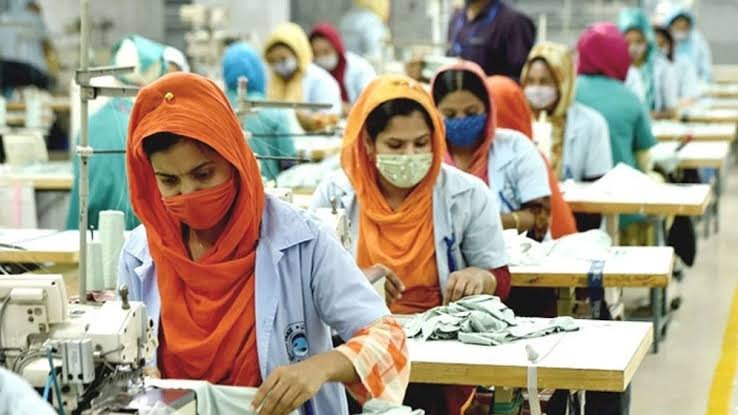
Desk Report:
The ready-made garment (RMG) and textile industry in Bangladesh has expanded over more than four decades. Driven by the efforts of workers, entrepreneurs, and local managers, this sector has become one of the country’s primary export industries. While Bangladeshi apparel has secured a strong position in the global market, the industry’s dependence on foreign personnel for high-level management and technical expertise remains significant.
Foreign nationals are frequently employed in critical roles such as production management, merchandising, dyeing and finishing, quality control, compliance, industrial engineering, and liaising with international buyers. Some entrepreneurs argue that foreign experts play a vital role in operating modern technology, enhancing productivity, and meeting the demands of global buyers. However, questions persist as to why, after such a long period of industrial development, a sufficient pool of skilled local talent has not been cultivated in these areas.
Research indicates a substantial disparity in compensation between foreign and local personnel. In similar roles, foreign staff may earn three to five times more than their local counterparts. Furthermore, there are concerns regarding a lack of transparency in the recruitment of foreign workers, the concealment of actual salary figures, tax evasion, and the risk of illicit capital flight.
According to data provided by Fayzur Rabbi, Deputy Director of ‘Invest Bangladesh’, there are currently 25,026 foreign nationals employed across various sectors in the country. This figure encompasses foreign workers across all sectors, not just the RMG and textile industry.
A.S.M. Anwar Parvez, Executive Director of the Bangladesh Export Processing Zones Authority (BEPZA), stated that there are 2,060 foreign workers employed within the Export Processing Zones (EPZs) under BEPZA’s jurisdiction. A large portion of them are engaged in merchandising and technical roles.
Additional insight into the ongoing employment of foreign personnel can be gleaned from data regarding work permits. According to the annual report of the Bangladesh Investment Development Authority (BIDA) for the 2024-25 fiscal year, a total of 15,898 work permits were approved for foreign nationals during that period. This figure comprises 5,491 new permits and 10,407 renewals.
In the preceding 2023-24 fiscal year, 5,761 new work permits were approved, while 9,947 were renewed. In other words, while the number of new approvals saw a slight decline, the number of renewals increased.
However, these work permit figures should not be interpreted as the total number of foreign nationals currently employed in the country, as the data includes renewals for the same individuals.
Mohammad Khorshed Alam, a director of the Bangladesh Textile Mills Association (BTMA) and chairman of Little Star Spinning Mills, noted that foreign professionals are employed in roles such as production management, dyeing, production supervision, and technical operations. A significant proportion of these individuals are citizens of India and Sri Lanka.
According to him, many organizations opt to hire foreign personnel due to gaps in the skills of the local workforce, particularly regarding experience with modern technology and the ability to operate sophisticated machinery.
Citing his own factory as an example, he explained that a facility that once required approximately 1,100 workers to maintain production now operates with about 350 employees, following improvements in technology, training, and management. He pointed out that a 54,000-spindle factory in China can be operated with as few as 80 workers. Using these examples, he emphasized the importance of bridging the gap in technology and skills to enhance productivity.
Fazle Shamim Ehsan, Executive President of the Bangladesh Knitwear Manufacturers and Exporters Association (BKMEA), stated that foreign experts are essential for installing and operating new technology, improving production efficiency, and training the local workforce. In many instances, these experts work for one to two years, during which they provide training to local staff.
Based on his own estimates, there are fewer than 100 foreign workers employed in the knitwear sector, while the woven garment sector employs more than 150. Depending on the position, their monthly salaries can range from 200,000 to 1 million BDT. However, this figure is not based on any government survey; it is an individual estimate.
Information regarding the salary gap between foreign and local personnel emerged in a 2020 study titled “Enrollment of Expatriates in the Readymade Garments and Textile Sectors of Bangladesh.”
The study, conducted by Saiful Islam and Tasnim Nabila Islam, involved interviews with 30 experts across various levels from 10 different organizations. It revealed that for similar roles, foreign personnel can earn three to five times more than their local counterparts.
The study cites examples where foreign general managers earn between 5,000 and 10,000 USD per month, while local personnel in equivalent positions earn between 150,000 and 250,000 BDT. It further notes that a significant portion of these foreign personnel are citizens of India and Sri Lanka.
The research also highlights the employment of foreign personnel in areas such as production management, merchandising, dyeing, cutting, quality control, industrial engineering, and senior-level management. However, the researchers characterize this as an exploratory study; due to the limited sample size, the findings cannot be used to determine the overall salary structure or the total number of foreign workers across the entire industry.
An official with 15 years of experience in the human resources department of the garment industry—using the pseudonym Md. Rafiqul Islam—stated that the recruitment of foreign personnel is not solely due to a lack of local expertise. In some instances, the preferences and influence of international buyers also play a role.
Some factories hire foreign personnel to maintain relationships with foreign officials and secure purchase orders. This practice risks limiting opportunities for qualified local staff to earn promotions or attain high-level responsibilities.
He further noted that in some organizations, while a local employee might receive a salary of 50,000 taka for a specific role, a foreign employee in a similar position is paid 150,000 taka or more. He alleged that, in certain instances, the salary stated in the employment contract is lower than the actual amount paid, with the difference being settled in cash. For example, an actual salary of 200,000 taka might be recorded on paper as only 100,000 taka. However, the situation would become clearer if the concerned organizations and tax authorities provided their perspectives on these allegations.
Transparency International Bangladesh (TIB) has long expressed concerns regarding irregularities in the recruitment of foreign personnel, as well as the risks of tax evasion and money laundering.
On February 5, 2020, the organization published a study titled “Employment of Expatriates in Bangladesh: Governance Challenges and Way-Out.” Subsequently, on March 30, 2024, an updated policy paper was released, titled “Employment of Foreigners in Bangladesh: Challenges of Good Governance and Ways of Overcoming.”
TIB’s research indicates that some foreign nationals enter Bangladesh on tourist, on-arrival, or business visas and proceed to work for various organizations without obtaining the necessary work permits. Even among foreign workers who are legally employed, there are allegations of income tax evasion through the underreporting of actual salaries.
The research further notes that, in some cases, only one-third of the actual salary is paid through formal banking channels, while the remainder is disbursed in cash. The study also highlights the failure to adhere to mandated ratios for local versus foreign employees, as well as the risks associated with the transfer of funds through informal channels (such as the hundi system).
In a 2020 estimate, TIB suggested that the number of foreign nationals working in Bangladesh at that time was at least 250,000. It was estimated that at least $3.15 billion was being siphoned out of the country annually through these individuals, resulting in a loss of approximately $1.35 billion in government revenue due to tax evasion. Based on the exchange rates at the time, these amounts were equivalent to approximately 264 billion BDT and 120 billion BDT, respectively.
However, TIB (Transparency International Bangladesh) itself noted that there is no reliable institutional data regarding the actual number of foreign workers or the total amount of money being siphoned abroad. Consequently, these estimates cannot be considered as definitive statistics for the current situation.
TIB has recommended the creation of a centralized database for foreign workers, the assessment of sector-specific human resource requirements, the regular updating of data concerning salaries and income taxes, and the enhancement of coordination and oversight among government agencies.
There is also an official record of funds remitted abroad through legal channels from the earnings of foreign workers. On June 24, 2024, the then-Finance Minister, Abul Hassan Mahmood Ali, informed the National Parliament that between July and April of the 2023–24 fiscal year—a period of 10 months—foreign nationals residing in Bangladesh remitted $130.58 million to their respective home countries.
Of this total, Indian nationals remitted $56 million, Chinese nationals $14.56 million, and Sri Lankan nationals $12.71 million. Additionally, funds were remitted by nationals from Japan, South Korea, Thailand, the United Kingdom, Pakistan, the United States, and Malaysia.
The Finance Minister stated in Parliament that Bangladesh Bank does not maintain comprehensive data on the annual income of foreign nationals residing in the country. Therefore, this figure encompasses legal remittances made by foreign nationals across all sectors—not just those employed in the garment and textile industry. Consequently, it is not possible to specify the exact amount of money being sent abroad from the garment and textile sector alone.
According to a directive issued by Bangladesh Bank on December 27, 2021, foreign workers are permitted to remit up to 80 percent of their net income—after tax deductions—to their home countries at any time. The remaining 20 percent may also be remitted, subject to tax assessment and certification by the relevant authorities.
The Bangladesh Garment Manufacturers and Exporters Association (BGMEA), the apex body for the ready-made garment industry, was also unable to provide specific data regarding the number of foreign workers or the amount of money remitted abroad by them. Mahmud Hasan Khan, president of the organization, stated that letters have been sent to member factories requesting information on this matter. He further noted that entrepreneurs in the garment sector are currently concerned due to recent labor unrest and overall instability within the industry.
Various initiatives are also underway to enhance the skills of the local workforce, with the aim of reducing reliance on foreign personnel.
On June 25, 2026, the BGMEA, BKMEA, BGMEA University of Fashion and Technology (BUFT), and the Export Promotion Bureau (EPB) signed separate Memorandums of Understanding (MoUs) to provide training to 22,815 workers, officials, and mid-level managers over a period of three fiscal years.
The training covers areas such as machine operation, compliance, production planning, inventory management, and leadership skills.
Additionally, on September 13, 2026, Mahdi Amin, an advisor and spokesperson for the Prime Minister’s Office, stated that it is possible to staff the ready-made garment industry entirely with a local workforce, provided that the necessary skills, quality education, and a conducive work environment are ensured.
Industry stakeholders acknowledge that the need for foreign experts cannot be entirely ruled out; their experience can be particularly valuable in adapting to new technologies, modern production systems, and international standards.
However, alongside the recruitment of foreign experts, it is essential to establish mechanisms through which they can train local personnel—effectively turning them into trainers themselves. Simultaneously, it is crucial to create opportunities for the promotion and leadership development of local staff within key management and technical roles.
Despite the industry’s growth over more than four decades, a reliance on foreign personnel for high-level management and technical positions persists. To identify the root causes of this dependence, it is necessary to maintain comprehensive, integrated records covering the recruitment, skill sets, remuneration, tax payments, and outward remittances of foreign employees.
A long-term plan must be developed that identifies which roles can be filled by local talent, where specific skill gaps exist, and the timeframe required to bridge those gaps. Without such a plan, even if the production and export capacity of one of the country’s largest export sectors continues to grow, it may remain difficult to overcome the persistent reliance on foreign expertise for high-level management and technical functions.