Desk Report:
Commerce Minister Khandaker Abdul Muktadir has urged the world to reduce its dependence on conventional export products and focus on new potential sectors. In this regard, he called for building a strong and international standard halal ecosystem by utilizing the experience of the ASEAN region.
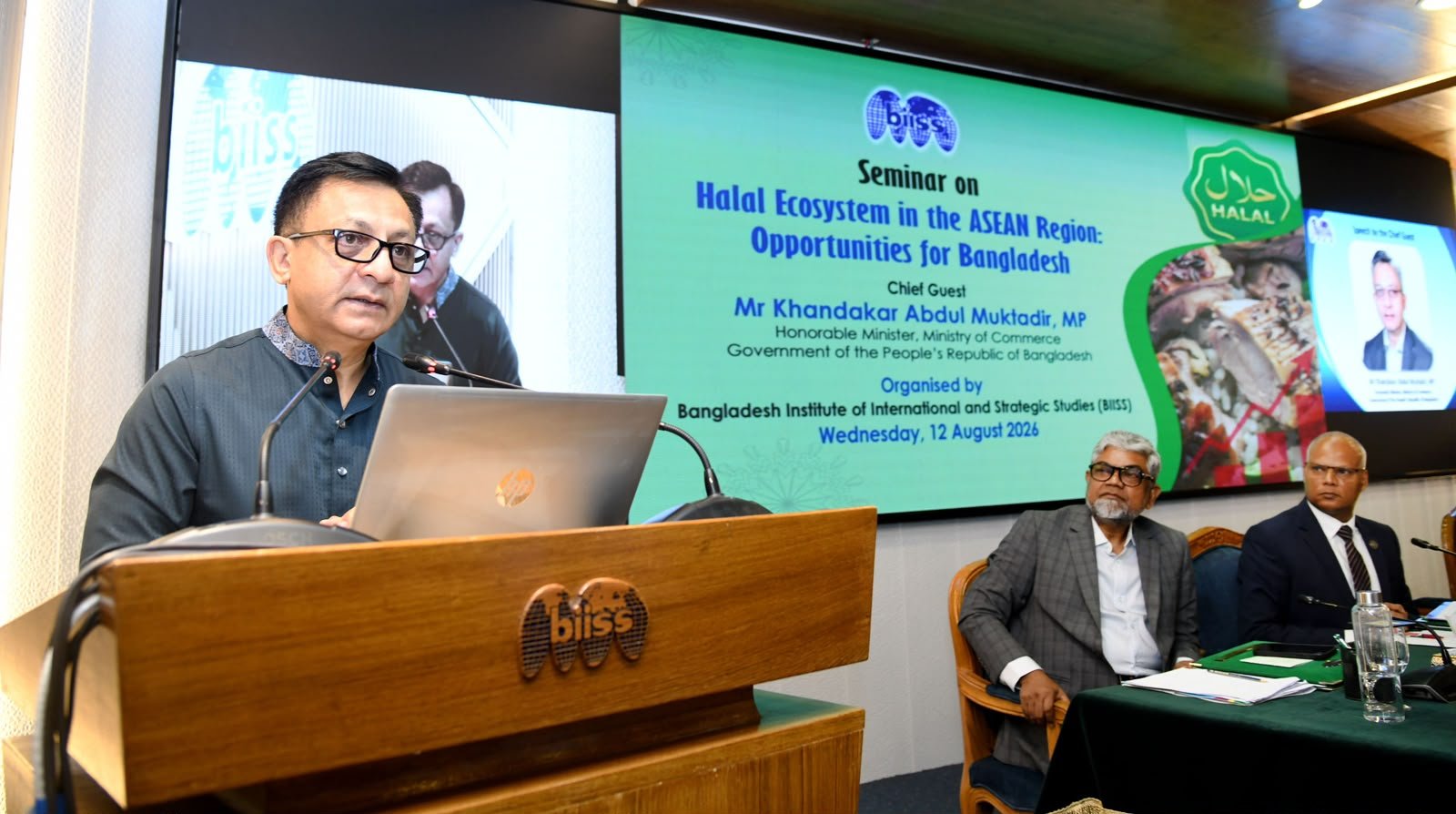
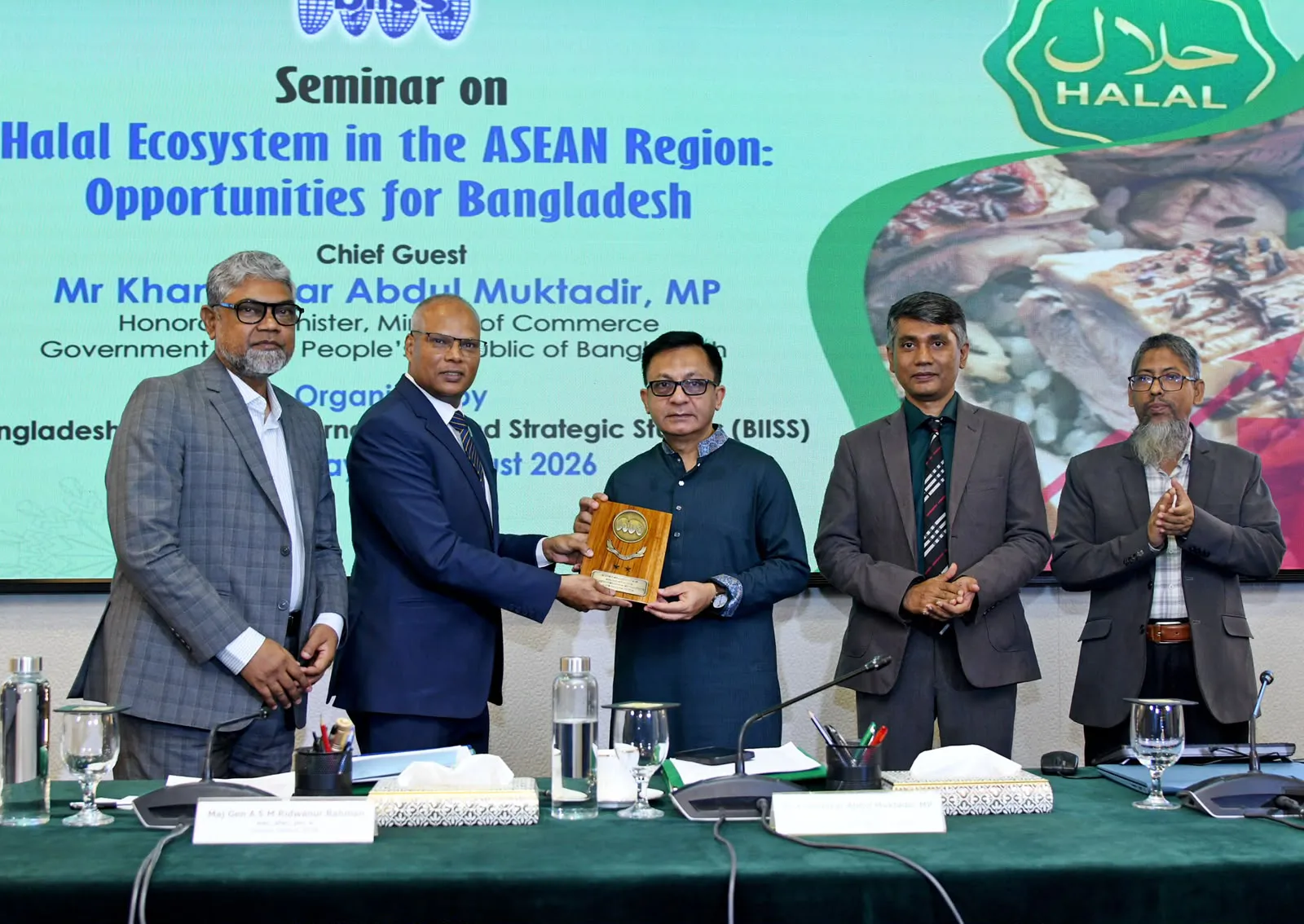
He made this call as the chief guest at a seminar titled “Halal Ecosystem in the ASEAN Region: Potential for Bangladesh” organized by the Bangladesh Institute of International and Strategic Studies (BIISS).
At the seminar, Commerce Minister Khandaker Abdul Muktadir said that the halal economy can no longer be limited to the food and beverage sector. It is currently a large global economic system combining food, medicine, cosmetics, modest fashion, tourism, logistics, technology, finance and international certification.
He said, “To increase exports, we must first increase our own production capacity. For this, domestic and foreign investment is needed and it is important to ensure a safe and attractive environment for investors.”
The Commerce Minister also said that preferential access of products to the global market is one of the main conditions for attracting investment. Initiatives are being taken to enter into Free Trade Agreements (FTAs), Preferential Trade Agreements (PTAs) and Economic Partnership Agreements (EPAs) with various countries to maintain Bangladesh’s export benefits after LDC transition.
He said that to utilize the potential of the international halal market, it is necessary to develop an independent, reliable and internationally acceptable halal certification system in the country. This will increase global confidence in Bangladesh’s products and help create new markets.
Speakers at the seminar said that although Bangladesh’s export sector has long been dependent on ready-made garments, diversification in both products and markets is necessary to survive in the future global trade. Halal economy can be one of the biggest areas of that new potential.
Experts said that the demand for halal products is increasing rapidly in different countries of the world. Halal quality is gaining importance not only in food but also in pharmaceuticals, cosmetics, fashion, tourism and lifestyle products. An integrated production, quality control and certification system is needed to enter this market.
The discussion revealed that Malaysia’s halal ecosystem among the ASEAN countries can be an important example for Bangladesh. The country has not seen halal as just a product; rather, it has transformed it into a complete economic system from production to research, certification, marketing and export.
The speakers said that Bangladesh has a huge domestic market, strong agriculture and food processing sectors, long experience in the pharmaceutical industry, leather industry and garment sector. By utilizing these capabilities, Bangladesh can become an important partner in the global halal supply chain in the future.
The seminar highlighted five strategic priorities to make Bangladesh’s halal sector suitable for international competition—
- Creating an internationally acceptable national halal assurance framework.
- Developing specialized halal industry clusters with modern laboratories and advanced logistics facilities.
- Making existing production sectors suitable for international standards and competitiveness.
- Involving small and medium enterprises (SMEs), researchers and young entrepreneurs.
- Establishing the “Bangladesh Halal Brand” in the global market through economic diplomacy.
BIISS Director General Major General ASM Redwanur Rahman delivered the welcome address at the seminar. BIISS Research Director Dr. Mahfuz Kabir presented the keynote address.
Islamic Foundation Halal Certification (Livestock) Deputy Director Akhtar Hossain and Bangladesh Standards and Testing Institution (BSTI) Deputy Director (Halal Certification) SM Abu Sayeed participated in the panel discussion.
The speakers said that if religious values are followed along with ensuring product quality, safety, transparency and international trust, the halal economy can become the new foundation for Bangladesh’s exports.
Now, what is needed is government initiatives, private investment, international cooperation and building an effective halal ecosystem. Through this, Bangladesh can establish itself not only as an exporter of halal products, but also as an important center in the global halal market.