Desk Report:
In many remote regions of the country, countless adolescent girls must travel long distances to reach school every day—often walking several kilometers or navigating through muddy, damaged roads. Beyond the arduous journey, concerns regarding safety frequently hinder these students from attending school regularly. This negatively impacts their studies and increases the risk of them dropping out.
In light of this, a major initiative has been launched to ease the commute for secondary-level female students and ensure they remain in the education system. Free bicycles will be distributed to the top three-ranking female students (first, second, and third place) in grades six through ten across approximately 20,000 secondary schools nationwide. A total of 300,000 students will receive bicycles under this program.
Initiated by the Ministry of Education, this program is expected to improve transportation for meritorious and underprivileged female students. Stakeholders believe it will help reduce dropout rates among girls at the secondary level and contribute positively to the advancement of women’s education.
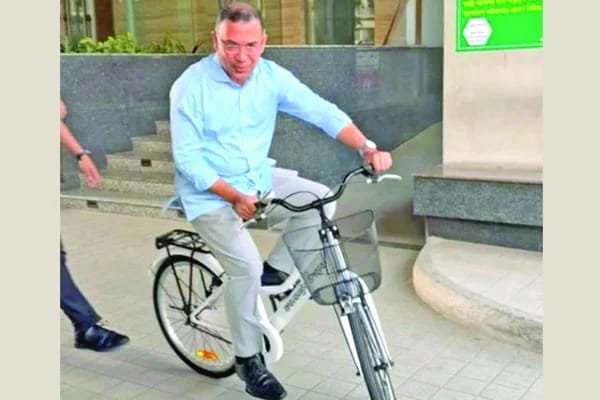
Prime Minister Tareq Rahman personally inspected the quality and functionality of the bicycles intended for the 300,000 students. On Wednesday morning, he tested various models of bicycles at the Secretariat, near his office.
When the Ministry of Education presented several types of bicycles for distribution, the Prime Minister test-rode them to evaluate their quality, usability, and other features.
Present on the occasion were State Minister for Public Administration Abdul Bari, Principal Secretary to the Prime Minister A. B. M. Abdus Sattar, Cabinet Secretary Nasimul Gani, Senior Secretary of the Ministry of Education Abdul Khalek, and other relevant officials.
Under this government initiative, bicycles will be provided to meritorious and underprivileged female students in grades six through ten across approximately 20,000 secondary schools. Students who secure the first, second, and third positions in their respective classes at each school will be eligible for this benefit. The primary objective of the program is to reduce the time and effort required for students from remote areas to travel to school, make their commute easier and safer, and ensure their regular school attendance.
For female students who become physically exhausted from traveling long distances every day, a bicycle will significantly alleviate that strain. Furthermore, it will save families the money previously spent on transportation.
Stakeholders believe that improved commuting options could lead to higher school attendance among girls at the secondary level. Additionally, addressing long-standing travel challenges and safety concerns is likely to increase their motivation to continue their education.
Keeping girls in the education system could also have an indirect, positive impact on preventing child marriage. In particular, providing girls from poor families in remote areas with the opportunity to attend school regularly increases the likelihood that they will pursue their education for a longer period.
A bicycle is more than just a means of transport to school; it can also serve as a tool for fostering self-reliance and self-confidence among adolescent girls. Commuting to school on their own bicycles will help them develop time-management skills, a sense of responsibility, and greater freedom of movement.
By reaching school quickly on a bicycle—rather than walking long distances—girls will have more time to dedicate to their studies and other creative pursuits. At the same time, reducing the financial burden of transportation on parents may encourage families to further support their daughters’ education.
Consequently, the introduction of 300,000 bicycles on the rural paths of Bangladesh will not only transform how students travel; it has the potential to reshape the educational journeys and future aspirations of countless adolescent girls.
Meanwhile, Prime Minister Tareq Rahman has emphasized the importance of transforming the livestock sector into a modern, science-based, and export-oriented industry.
He made these remarks in a message issued yesterday on the occasion of ‘National Livestock Week 2026.’
The Prime Minister noted that there is significant potential for Bangladesh to export halal meat, dairy products, poultry, and leather goods to the international market. Bangladesh has, for the first time, exported fertile eggs—or “hatching eggs”—capable of producing chicks on a commercial scale.
‘National Livestock Week 2026’ will be observed from today until November 28. The theme for this year is: “Building the nation through export-oriented livestock—Bangladesh first.”
The Prime Minister has wished for the overall success of National Livestock Week 2026.