Desk Report:
Khandaker Abdul Muktadir, Minister of Commerce, Industries, and Textiles & Jute, has expressed hope that a decision regarding a three-year postponement of Bangladesh’s graduation from the Least Developed Country (LDC) category will be reached within this October. He stated that the government has developed a time-bound action plan to utilize this additional time for preparation. Furthermore, there is an objective to conclude negotiations for a Free Trade Agreement (FTA) with the European Union (EU) prior to the graduation.
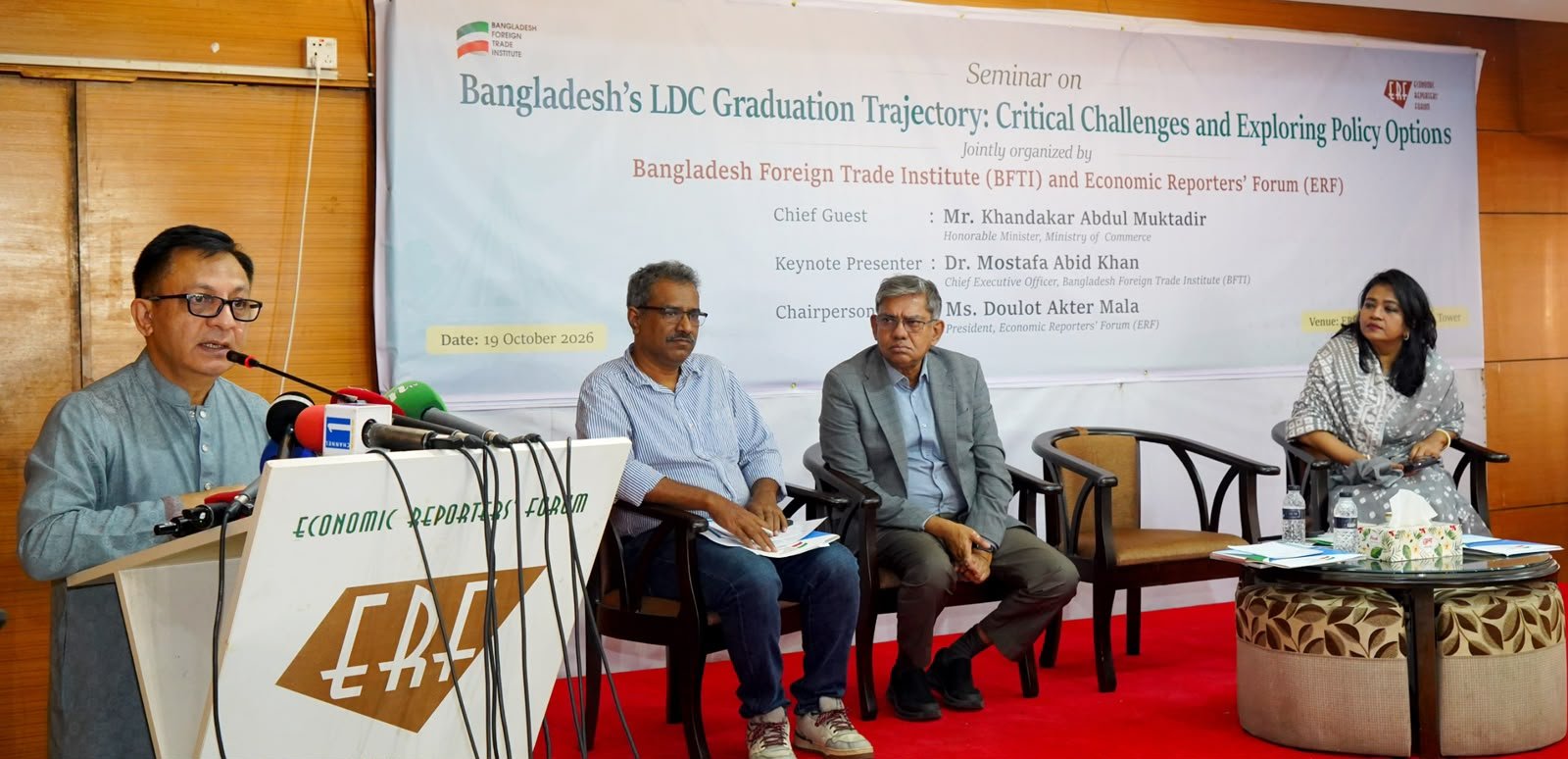
The Minister made these remarks while serving as the chief guest at a seminar—organized jointly by the Economic Reporters’ Forum (ERF) and the Bangladesh Foreign Trade Institute (BFTI)—which focused on the challenges and necessary measures surrounding Bangladesh’s LDC graduation.
Outlining the progress of the postponement process, the Commerce Minister noted that Bangladesh has already cleared the stage involving the United Nations Committee for Development Policy (CDP). Subsequently, a request for a three-year extension has been placed before the UN Economic and Social Council (ECOSOC). According to the Minister, relevant stakeholders, including the European Union, have reached a consensus regarding the granting of this additional time to Bangladesh.
Khandaker Abdul Muktadir stated, “I am very optimistic that we will see a resolution to this matter either next week or the week after.” He expects a final decision to be reached well before the scheduled deadline of November 24.
Explaining the rationale behind requesting a three-year extension, the Minister remarked that the country was not adequately prepared to address the challenges that would follow graduation. He observed that there had been a tendency to glorify the graduation politically, rather than focusing on the underlying economic and financial challenges. In his view, insufficient attention was paid to leveraging the potential benefits of graduation or building the capacity to mitigate its associated risks.
The Minister further mentioned that a time-bound action plan—detailing how the additional time would be utilized—has already been shared with the European Union. Khandaker Abdul Muktadir highlighted initiatives to establish trade agreements with various countries, aimed at securing continued access for Bangladeshi goods and services to the global market. He stated that the goal is to finalize Comprehensive Economic Partnership Agreements (CEPA) or Free Trade Agreements (FTA) with eight to ten countries by 2026–2027.
The Minister noted that a chief negotiator has been appointed for FTA discussions with the European Union (EU), and preparations for the first round of technical talks are underway, though a specific date has yet to be set. The objective is to conclude these negotiations before Bangladesh’s graduation [from its current LDC status].
The Minister also mentioned that preparations are running in parallel to secure ‘GSP Plus’ status in the EU market. “However,” he added, “I hope we won’t need to rely on the GSP Plus option, as we aim to finalize an FTA before that becomes necessary.”
Furthermore, he stated that the process for joining the Regional Comprehensive Economic Partnership (RCEP) is ongoing. According to the Minister, in-principle approval for Bangladesh’s inclusion has been granted, and the procedural steps are now moving forward.
To boost investment, the Minister emphasized the need for—alongside access to international markets—a reliable energy supply, simplified business processes, and transparent legal mechanisms for dispute resolution. He stressed that it is essential to ensure both domestic purchasing power for locally produced goods and access to foreign markets for exports.
Citing the protracted nature of starting a business, the Minister pointed out that the entire process—from obtaining trade licenses, opening bank accounts, and securing initial clearances to acquiring an Import Registration Certificate (IRC) and opening Letters of Credit (LCs) for machinery—takes an average of 355 days. Such a long duration makes it difficult for entrepreneurs to maintain their enthusiasm.
To address this, he outlined a plan to issue trade licenses through a unified online portal. The Minister explained that applicants would be able to obtain a license from anywhere—within the country or abroad—by submitting the required documentation and paying the necessary fees. The fees would then be automatically routed to the relevant local government authority. The minister stated that initiatives are underway to move all services of the Registrar of Joint Stock Companies and Firms (RJSC) entirely online and to extend the validity period of various licenses from three to five years. He also proposed replacing separate, individual inspections by various agencies with a unified, integrated inspection system.
Khandaker Abdul Muktadir expressed hope that these reforms would, by 2027, eliminate the current situation where entrepreneurs are forced to spend long periods securing licenses and permits.
Identifying the energy crisis as a major obstacle to new investment, the minister noted that work is ongoing to install new floating LNG terminals and drill gas wells to increase supply. Simultaneously, the government is taking steps to boost solar power generation.
He remarked that the lack of adequate stockpiles for LNG and essential commodities leaves Bangladesh vulnerable to pressure whenever uncertainties arise in international supply chains. Consequently, he emphasized the necessity of building strategic reserves and storage capacity.
Khandaker Abdul Muktadir stated that the government is moving forward with a comprehensive objective: to bolster the confidence of both domestic and foreign investors, simplify business processes, and facilitate access to global markets.
The seminar was chaired by Daulat Akter Mala, President of the Economic Reporters’ Forum (ERF). The keynote paper was presented by Dr. Mostafa Abid Khan, Chief Executive Officer (CEO) of the Bangladesh Foreign Trade Institute. The event was moderated by SSM Moinul Haque, a member of the ERF Executive Committee.