Desk Report:
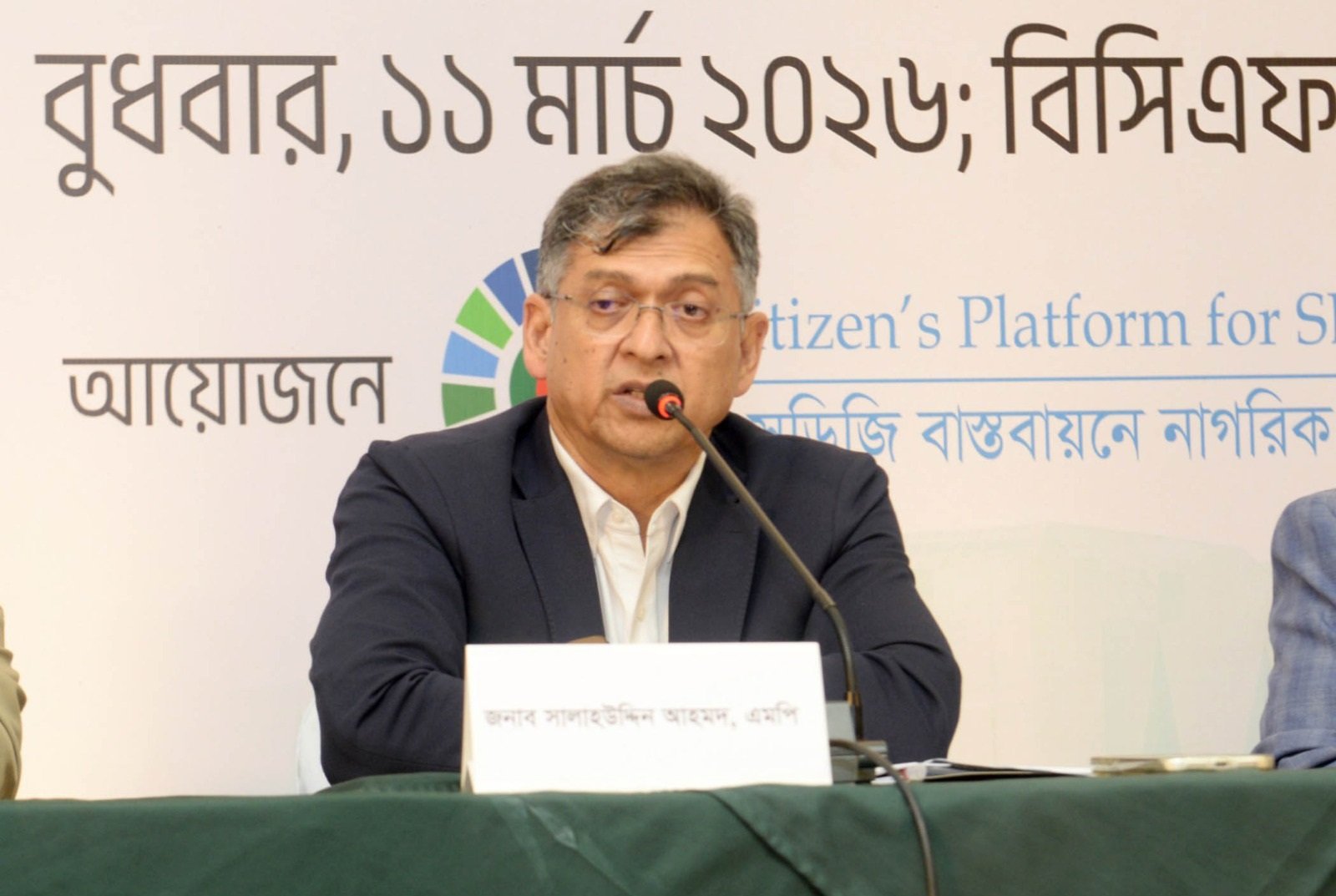
Home Minister Salahuddin Ahmed said, we are trying to improve the existing political culture in stages. However, it is not possible to implement it overnight, it will take time. We want to practice good democratic practices; we want to bring good political culture by eliminating the bad culture of the past and practicing, creating and nurturing good culture. And we want to start practicing good political culture from the National Parliament.
The minister said these things while speaking as the chief guest at the dialogue titled ‘Human Rights Commission Ordinance 2025: Expectations for the New Parliament’ organized by ‘Citizen Platform-Reform Watch’ at the Bangladesh China-Friendship Conference Center in Dhaka on Wednesday (March 11, 2026).
Convener of Citizen Platform and Fellow of the Center for Policy Dialogue (CPD), Dr. Debapriya Bhattacharya, participated in the dialogue, chaired by Barrister A. M. Mahbub Uddin Khokon, Advocate Md. Fazlur Rahman, Barrister Rumin Farhana, Advocate Ahmed Azam Khan, Professor Rehman Sobhan, Advocate Subrata Chowdhury, Barrister Sara Hossain, women’s leader Khushi Kabir, etc.
The minister said, since we have seen serious human rights violations in the fascist regime, especially using the state machinery. That is why as a political party or nation, we are committed to protecting human rights; especially the protection of basic human rights as mentioned in the constitution. He said, the issue of protecting human rights is in our promise and election manifesto. It is also in our 31 points. In the manifesto, we have talked about setting up commissions on various issues, including human rights and the Truth and Healing Commission.
The minister also said, so that the level of human rights violations in the country comes down to zero in the future, we have to go for human rights development in stages. It is not possible to protect human rights 100% overnight. He said, we want to improve Bangladesh’s human rights standards and indicators at the international level. For that, we need to give it time. We know who, how and through what process can hinder its implementation. For that, some time is needed.
He also said, we have agreed on almost all the issues in the Human Rights Commission Ordinance. Amendments may have to be made in some issues, which will be raised in the form of bills in the parliament.
Regarding the 133 ordinances issued during the tenure of the interim government, the Home Minister said, we may be able to accept most of the ordinances issued by the interim government according to their ideas and concepts in their exact form. However, there are several ordinances that deserve discussion. He said, since there is a constitutional obligation, these ordinances must be accepted in the form of lapses, passes or amendments within 30 days from the date the session of the National Parliament is convened. Since there is a shortage of time, 30 days (not 30 working days), this will also include the closure or holidays in between. Therefore, the ordinances that we cannot bring in the parliament will automatically lapse, but we will be able to bring them in the form of bills in the next session.
The minister said, we will also give an opening speech in the parliament. We will do whatever is possible within 30 days of the first session of the parliament. Of course, the ordinance of the Human Rights Commission will be among them. Among these ordinances, there are 7 ordinances under the Ministry of Home Affairs.